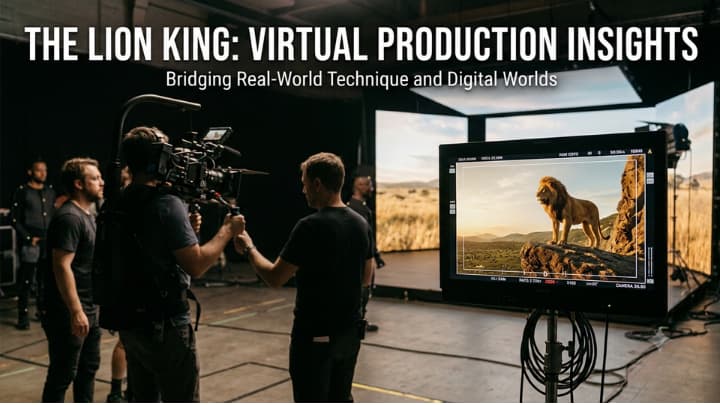
Lion king has been a milestone movie in the genre of 2D and 3D Animation. The latest animated version is already creating ripples in the media.
Apart from traditional Animation and VFX pipeline, it has also adapted the route of virtual production. The dedicated blog article deep dives in the process of The Lion King Virtual Production.
What is Virtual Production?
Initially, let us just rumble-up through what is virtual production or virtual features and their reality?
It is the virtual production platform where physical and digital worlds meet. Virtual production lets its directors to work on a motion capturing platform. It has been around the globe for several years now. An early version of the same had been used in ‘The Fellowship of the Ring’. However, ‘Avatar’ was a climactic moment.
Initially, digital assets and the environment is built-up and then later combined with digital puppets. These digital puppets are driven by motion capture (mocap). The improvement of virtual production is going on day-by-day to allow more freedom to the filmmakers to implement their unique and creative ideas in the right direction within a digital environment. Virtual production has and will continue to grow to change the cinematic industry forever.
The film ‘The Lion King’ has made a tremendous impact on the people because of its virtual production utilization in an effective and efficient way.
Implementing the The Lion King Virtual Production
‘Lion King’ Disney’s remake has featured kind of creature animations that have led at least one film critic to believe and conclude that some of the film’s lions and hyenas were real and not virtualized. They are captured in such a way that it may lead you to believe that it was actually an actual person standing right behind a camera who was enacting the scene on an actual location. They were that level photoreal!
Ever wondered what has made them so convincing? A part of it is meticulous attention to the fine details of the real animals that have helped in inspiring the characterizations and locations of the film. The remaining leftover part is the staunch attitude and attempt of director Jon Favreau too put his crew at an ease and let them work in harmony and in the traditional film-making method which introduces getting in bed with virtual reality. The movie’s production notes have helped in revealing this which were published by Walt Disney Pictures.
The human actors who performed in ‘The Lion King’ have worked and acted in a black box. Rather than standing in a stationary position and reading out the script lines, the actors were told to enact their scenes in a black box for more efficient and effective results. Rob Legato the VFX supervisor mentioned that stage environment helped the actors in delivering real and bold performances as references for animators.
Legato also mentioned that they shot the scenes with multiple cameras so the animators could figure out the intent of the actor even though it wasn’t a direct translation as they weren’t an actual animal. “But when they pause and then look and you watch them thinking, you quite well understand and know that that’s what drives the performances. Also, reading off the script off of pages is way more different than interacting in a scene and kick-starting of your ideas.”
Shooting locations to film The Lion King movie
To pick up unique locations and study the native animals for the film, the team pulled in a lot of efforts. Thirteen members of the crew went on a two-week-long Safari in Kenya in 2017 including Legato, MPC Film VFX supervisor Adam Valdez, animation supervisor Andy Jones and DP Caleb Deschanel. They brought along with them from the safari approximately 2,200 pounds of camera equipment and 12 TB of photographs, video content of the animal movement. They also scanned actual rocks which would be a part of the movie’s animation and landscape.
The digital exposure in the film was inspired by real locations. For instance, Pride Rock was inspired by the rock formations in Chyulu Hills which was situated in southeast Kenya. The elephant graveyard reference came from tufas which is in Mono Lake, California and geothermal areas in Yellowstone National Park.
You use a tool in the new technological advancements in order to populate the savanna with the assets or to concoct that will repeat and then later you can apply them everywhere and anywhere. This was explained by the MPC Supervisor Audrey Ferrara. He also mentioned that one still needs the human eye to keep it in order, as it can become messy real quick. At times it just suddenly appears right in front of your eyes and you keep thinking if it is real or animation! You won’t be able to tell the difference between the two. Favreau was always inspired and believed in nature-based documentaries.
They also set out to create something utilizing these mythic archetypes which feel natural and give a real vibe. They even took an effort to watch nature documentaries to get an idea regarding how beautiful it would look and how lyrical would it be in nature when photographed and scrutinizingly edited with good music to create a unique story. The production of the film took place in Playa Vista, CA. The new facility included black-box theatre. It became a VR volume for production later on. It also included two screening rooms, the Simba and Nala theatres. Favreau mentioned that he wanted to make it look like a tech company, thus the campus type environment. They had food trucks pull up for the crew or Favreau himself cooked for them.
‘Avatar’ broke the ground by providing the filmmakers an eye-like window on the VFX world where they could see the CG environment in real-time production as if they were looking at it through a camera’s viewfinder. The lion king inverts this by putting the filmmakers and their gear inside a game engine that relinquishes the world of the film.
The Lion King Virtual Production: Feel and Development
The scenes which were shot had set a motive to feel real. It was all about aping. To not make the film seem like it was made with a computer rather than photographed at least, the virtual production created physical representations of traditional gear. Favreau believed that this would help the film. Cranes, dollies, emulated Steadicam rig and an emulated handheld camera rig were all utilized. “Instead of designing a camera move as you would in previs on a computer, we lay dolly track down in the virtual ecosystem,” Favreau stated.
The virtual reality production is helping the filmmakers’ process. Virtual reality has always been about the fire of complete raptness which is exactly how we want the people to approach life and their work. Actors can actually help imbue other people through the world of virtual reality they are helping to create.
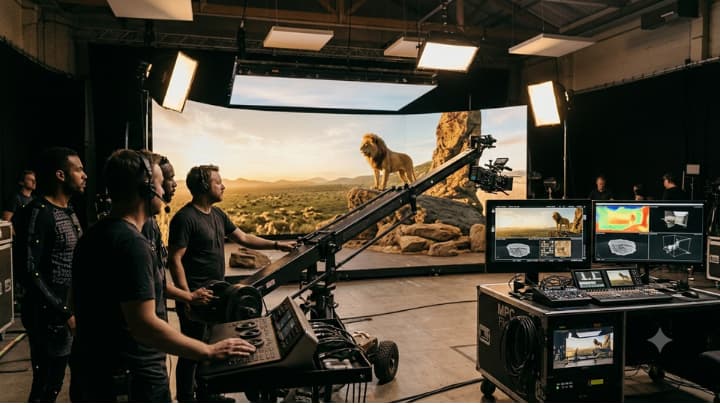
The development of the characters of the film was a nine-month procedure. It required creativity and sharp thinking to translate an animated character into a photographed realistic creature. The character illustrators would produce both 3D and sculpts and paintings of the characters which went through rounds of reviews with Favreau and the team. They dug deep into research for the characters’ ideas.
The final designs were sent to the artists at MPC, which would modify the designs if needed at all to give them a final polish for better and improved simulation. To make it seem like the animals were actually talking, the animators tried tilting the heads down of the animals which helped in not staring at their mouths. They found lip-sync through that approach-moving mouths into various different shapes which resembled into similar movements of the mouth which opened to speak.