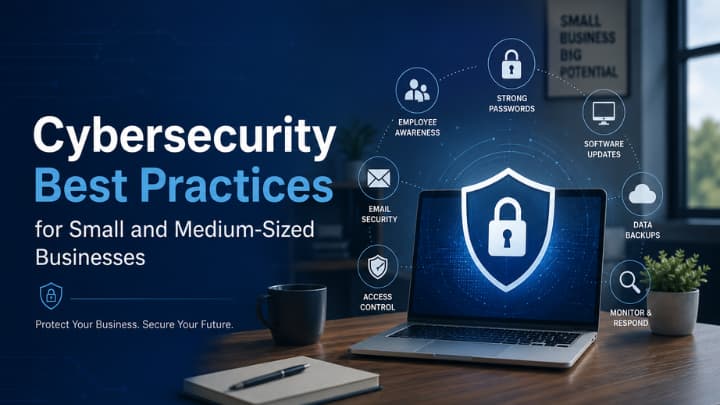
Cybersecurity is longer a luxury that only big companies can afford, it’s all but required for businesses of all sizes. In recent studies, it was revealed that almost 43% of attacks target small businesses and medium-sized businesses (SMBs) in particular are vulnerable.
The fortunate aspect is that having robust cyber security habits does not need complicated infrastructure, or large spending on IT resources. The use of basic hygiene principles can help minimize risk for SMBs and secure important information, customers and brand.
It can be helpful to know before you put measures in place, why SMBs are these delicious targets of cybercriminals. Small businesses are often seen as having the ‘sweet spot’ of weak points, with valuable data and information about their customers, but with not the same level of risk awareness and strong security as larger businesses. The usual attacks consist of:
- Ransomware attacks
- Phishing emails
- Data breaches
- Malware attacks
- Credential-based attack
Such risks can result in substantial financial loss and disruptions to operations, as well as damage to customer confidence which can be irreparable.
Create a strong password policy
Of course, one important and easy-to-implement cyber hygiene measure is to have a sound password policy. Although cybercrime is established as the top source of security breaches, using weak passwords continues to be a factor. Know and enforce policies that include using strong, unique passwords that are 12-16 characters, composed of uppercase and lowercase letters, numbers and special characters. Offer and/or mandate alternate password providers such as Bitwarden, 1Password or LastPass that have secure storage and creates strong passwords.
Also, change passwords frequently and do not share passwords between accounts and employees.
Better yet, use multi factor authentication for any critical systems! By making users key two or more devices before being able to log in, this second form of authentication makes it exponentially more difficult for hackers to compromise if they’ve obtained the user’s password.
Make employee training and awareness a priority
Employees are the first line of the defense system that is need to fight against the cyber threats. Here need to phishing the attempts, social engineering and other tactics to manipulate staff are common methods for cybercriminals to exploit employees. Next step is need to produce a routine for the cybersecurity training courses and keep the staff updated on recognizing suspicious emails or links and reporting security concerns.
Keep training relevant and action-oriented. Don’t be theoretical, use real life examples, and take the people on simulated phishing trips to test their awareness.
You need to establish a culture and need to give a idea for the everyone is responsible for security. Have you cleared this reporting protocols in the place so employees can feel at ease reporting suspicious behavior if they see it, without the risk of reprisal.
Understand that it is impossible to eliminate human error and that the aim is to limit human error by education and support.
Ensure that software and systems are kept up-to-date
Outdated software presents an opportunity to the cybercriminals. There are multiple vulnerabilities that are going to use the widely-used applications and operating systems are found and exploited. Adopt a robust update and patch management policy that ensures that all the devices and applications are updated quickly on security related issues.
Apply fixes using a regular update policy.Preferably monthly for non-critical situations, more frequently for critical security fixes. Automated patch management eliminates the need for manual work and eliminates the fear of missing anything. These include operating systems, browsers, plugins, extensions, and other popular (and necessary) third-party applications that employees use daily.
Secure your network infrastructure
For any cybersecurity system, the network is one of the most important key factors. There is a first step that is used and it is fit for a solid firewall with an inbuilt package to watch and manage network traffic that comes in and out of your environment. Keep Wi-Fi networks secure with at least WPA3 encryption and individual passwords. If WPA3 is not an option, use WPA2 encryption and strong, unique passwords.
You may think about the segmentation of the network, that is used when networks are segmented into various zones. This restricts lateral movement and compromised this for the helps prevent sensitive data from being easily accessed throughout the network.
Also, use SHA256 data hashing to ensure data integrity checks. A SHA256 Generator tool will help create cryptographic hashes of important files, which will help to ensure that important data has not been altered or corrupted by malware. In addition, it is essential to conduct periodic surveillance of the network to detect irregular or suspicious behaviour and hijackings.
Incorporate data backup and recovery plans
Losing valuable data due to ransomware, hardware failure or disaster can be an incredibly costly problem for small business. Create an extensive policy to back up important files following the “3-2-1” rule: three copies with two different media types, one copy offsite.
Test your backup strategy regularly to ensure that it will run if you need it to do so.
When it comes backups, go with cloud based choices for elevated system scalability and accessibility or with local setup for quick recovery time. The principle of ‘Redundancy’ is the key here: When one backup goes down the rest of them are still parallel available. Have a complete written recovery plan and have several team members know what to do.
Regularly assess your security situation
To do, you can hire routine security evaluations.
Conduct own security reviews and assessments on a regular basis. Know your security needs and weaknesses and gaps in security today. Many small businesses can also profit from hiring and hiring 3rd party security consultants for penetration testing and vulnerability assessments, that replicate real attacks or exploit potential vulnerabilities.
Here you need to utilize the getting results for these assessments and plan to prioritize improvement and efficiently allocate resources. Security is not a “one and done” – it needs to be continually evaluated and adjusted it to fit the future threats.
Identify and report incidents
Create an incident response plan which includes incident detection, response and recovery procedures. A communication strategy, an incident response team and documented response procedures with regard to breaches should be part of this plan.
Use continuous monitoring solutions to help notify you of any unusual activity. Security logs & information security event management (SIEM) tools can assist you in monitoring and analyzing your security events throughout your infrastructure.
Conclusion
To comply with cyber protection in SMBs, you need technology, processes and people layers in combination.
You need to implement the robust password policies and regular employee training. Lets keep in mind next time for the cyber security that is not a one-and-done proposition. Stay updated on new risks and continually adapt and improve your security strategies to counter them.