You are seated at your desk. The cursor blinks. The page looks like it’s empty, white, and judgmental. You have been looking at it for 20 minutes and what you have written is your name, you deleted that too because it felt rude to imply that you could write something that’s nothing.
Writer’s block is real. It’s a true psychological condition, and it shows up for all new writers of a novel and professional journalists alike. There is a very sad disheartening part of all this is that the more you push a good idea, the more your mind will refuse to cooperate. It turns out creativity doesn’t do well under pressure.
The solution? To many new writers, the answer is a very unexpected one – a random sentence.
Why randomness works
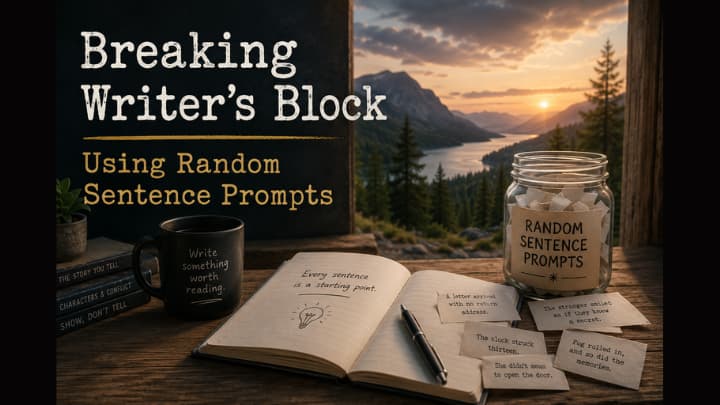
The creative brain loves the “out of the box” ideas. If you are feeling dreadful in front of a blank page with the desire to write something worthwhile. But then comes the small text generator. It says:
- The lighthouse keeper had not spoken to anyone for eleven years
- She found the receipt in a coat she hadn’t worn since the funeral.
Or, something similar.
Your brain halts the creation and begins reacting. The pressure lifts. There were you are not creating a masterpiece out of thin air anymore. Now , you are responding to a cue.
Suddenly you are following a new line and going wherever it goes. The random sentence is a back door into your imagination, the front door being guarded by the critical gatekeeper.
This is referred to as incubation in psychology, the unconscious mind working on a problem even when the conscious mind is not. A random prompt is simply a way of subconsciously make your mind go into incubation without making your fingers idle.
What is a Random Sentence Prompt?
A random sentence prompt is a sentence that has been dropped into your lap for no apparent reason and to no one’s surprise; often weird, specific, or emotive. It might be:
- 3 years later, the dog returned.
- There were not any one part at the party who said that the chandelier was burning.
- The user left the letter behind but it did not mail it.
These mentioned or added sentence lengths are intentionally unfinished. If they are going to ask questions but do not answer them. Who is this person? What happened before? What happens next? It’s the human appetite for narration, the desire to understand, that naturally springs into action. In no time at all you will be writing.
One of the things that make a random sentence prompt so beautiful is that it’s democratic. It doesn’t require you to be a genius. It just is asking you to do what has already been done.
How to effectively use random sentence prompts?
There are so many. But, my personal favourites are:
1. Don’t need to overthink with your first response: Think of the most original and ridiculous answer to the prompt that comes to mind, regardless of how it fits with your work. Start reading to prompt and think of the most original answer you can come up with. No matter what it has to do with your work. In the first five minutes, it’s about momentum, not quality.
2. Select a timer: Let’s set a timer for 10-15 minutes and write continuously on the prompt. No editing, No deleting, No rereading. Just forward motion. It splits the generative human brain from the editorial brain and both are better off without each other.
3. Allow the prompt to take you off-road: Don’t despair if your sentence prompt is a lighthouse keeper and you’re writing a corporate thriller. Write the lighthouse keeper. In the side path, some metaphor, structural concept or plot turn comes out of nowhere. The subconscious mind has its own navigational system.
4. Don’t wait for prompts to be ready: This is a little like that when ever you will bought a umbrella after the rain has started. Keep a running list of interesting sentences from books you are reading, overheard conversations, news headlines, or from special prompt generators. Once the block has struck, you will have an array to your disposal.
5. Do not convey the plot, convey the emotion: You do not need to literally include a prompt in your writing like “She realized she’d been holding her breath for years”. That feeling of relief and quiet exhalation may be the one you need in your scene. Remove any emotions from the prompt and place them in your writing.
Random Prompts for different types of writing
Not all sentence starters are for fiction writers. They tend to do a great job when they are translated into other forms:
- For essayists: An unexpected thesis might be a random sentence. At the initial stage start with a discussion of the argument that is implied in the prompt. Here is a sentence please read “Forgetting is not always a failure” can serve as the main idea for a essay writing about grief, memory, or growth.
- Journalists and bloggers: Look for a lede to your prompt. The best random sentence is as specific, as fascinating and as driving forward as a great opening line. If the sentence makes a good introduction, develop your piece around the questions it poses.
- For poets: Random sentences are like pressure cookers for imagery. Disassemble the sentence and let the pieces come back together to become something lyrical.
- Screenwriters: Use the sentence as your scene description. Who is in the room? What just happened? Who’s talking? Random prompts work especially well for writing dialogue which is subtext-heavy.
The Science of starting
Studies and research in creativity always reveal that the most challenging aspect of creativity is getting started. When you get something on the page, anything, the cushion is taken off the shoulders. The brain shifts from the anxiety of creation into the more comfortable mode of revision and continuation.
That’s why the random sentence prompts work not only as a writer’s block cure, but as a preventative as well.
They are used by many professional writers to get the creative juices flowing at the beginning of each writing session, even if they aren’t blocked, just to warm up the creative engine before firing it up. This is similar to stretching before running. It doesn’t mean that you can’t run without stretching, but you can run better with stretching!
About bad directions
Now and then you will find yourself being taken aback to a strange, dark, and apparently worthless ‘Extract Emails from Text prompt’. Write it anyway. Some of the most surprising creative breakthroughs occur when writers take a cue and venture into what is not right. Original work lives in the unfamiliar, and wrong is often synonymous with unfamiliar.
One of the essential tools a writer has is the waste paper basket, either real or virtual. Not all the responses to a prompt must be alive. The important thing is that something came and that by writing it, whatever was frozen was loosened.
Conclusion
This is normal, happens with all.
So, take your time and follow the above given practices. It will help you to get out of writer’s block.