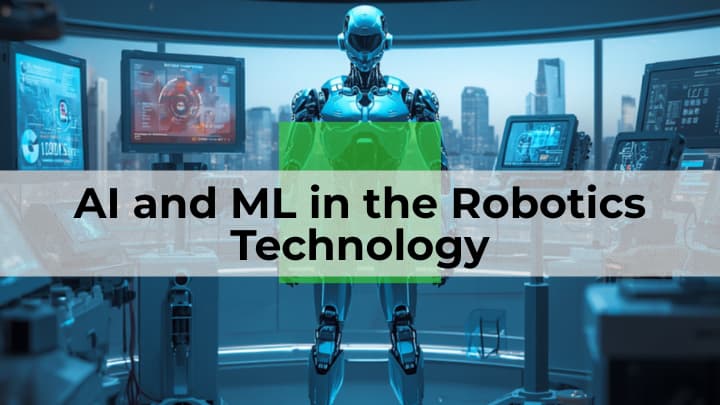
Modern industry is defined by automation. From factories and distribution centres to hospitals and farms, Automated systems in all of these areas are helping organizations improve their efficiency and productivity. Automation is not only changing industries, but robots used for automation have also changed over time. Check out the in-depth case study of AI and ML in the Robotics Technology.
Many traditional robotic systems were designed to carry out repetitive tasks based on fixed instructions. While traditional robotic systems were very effective in controlled environments, these systems often struggled to process unexpected conditions or scenarios.
With advancing technology, specifically in the Robotics Technology Market, we are seeing a shift to intelligent automation. This shift is occurring due to advances in artificial intelligence (AI) and machine learning (ML) capabilities that are allowing robots to go beyond just carrying out predetermined programming. Now, they are able to overcome the difficulties of real-world challenges.
Rather than simply have the robot obey a command, intelligent robotic systems and their capabilities now include the ability to analyze data and identify patterns. They can also store data in memory, and make decisions about what courses of action to take based upon the current state of their environment.
As intelligent robotic systems continue to be developed, the way we view automation will change. Intelligent robots will be more flexible and have the ability to take on and handle a wider variety of complex tasks than ever before. They will continue being able to work at the side of human operators. Advances in AI and ML technology are also making it possible for robots to continue to evolve in their capabilities, expanding the implementation of robotics in various industries.
What is AI and ML in Robotics?
Robots and robotic systems perform two separate functions in robotic systems (i.e., artificial intelligence and machine learning), although they are frequently mentioned together.
Artificial Intelligence (AI) is the general term that encompasses all types of machines that are capable of completing tasks that usually require a person to complete. Examples include:
- Reasoning
- Decision making
- Visual identification
- Understanding language
- Problem solving
AI is the broad definition of all types of computers/machines that will perform tasks for humans.
The term Machine Learning (ML) refers to an area of artificial intelligence that gives robots the ability to learn from input data by recognizing patterns in data. The use of ML allows companies or people to develop systems that can recognize patterns in data without having to use explicit rules.
The use of AI and ML will help to make robots more adaptive and responsive. A robot that utilizes AI would interpret its surrounding environment (sensing it), whereas ML would help improve the robot’s performance based on its past experiences. The combined use of AI and ML makes robots much better equipped to function effectively in an environment that is constantly changing or evolving.
The shift from Traditional Automation to Intelligent Automation
Industrial automation has primarily been focused on executing tasks that are predictable and repetitive. In other words, doing the same thing over and over very precisely. For a long time, this approach has created significant increases in productivity within the industrial environment. This is specifically true in situations where processes are consistent.
However, traditional automation systems have their limitations. If a product is changed, an object becomes misaligned or an accident occurs. Traditional robotic systems may require manual assistance or reprogramming in order to continue operating. The success of traditional automation systems largely depends on operating in an environment that continues to be predictable.
AI-enabled robotics provides a new approach to this issue as they provide robotic systems that utilize artificial intelligence (AI) to analyze incoming data from sensors, interpret their environments visually or otherwise and then make adjustments to their activities. Therefore, if there is a change in conditions that necessitates changing the way they are currently operating (i.e., stopping operation), these systems will be able to quickly adapt and respond to the change.
This type of flexibility and ability to manage variability is one of the many reasons that AI and machine learning are becoming increasingly important to companies that are looking to implement new automation technologies.
How Robots learn from Data?
The basis of machine learning is data, which can be gathered by machines via cameras or sensors; robots utilize these methods of gathering information to continuously monitor their environment.
The algorithms that provide the machine with data are used to analyze it and discover patterns or relationships. The more data a given machine receives, the better it understands the data it has received and will continue to improve on how effectively it can perform its task.
An example would be a robot in a distribution centre moving inventory from one point to another. At first, it may have a very basic navigation configuration. Over time the machine will begin to recognize familiar locations and develop the ability to efficiently navigate to reach them. In addition, it will develop the ability to determine obstacles that are routinely encountered, and to optimize its own motion based on prior experience.
Another example would be a quality control robot, which can improve its capacity to identify defects by processing the same number of images of various products. The machine will become increasingly accurate in determining what constitutes a defect as it processes thousands of images.
Ultimately, the machine will continue to adapt to perform its function more successfully without having to have constant adjustments made by an operator.
Key technologies driving Intelligent Robotics
The combination of many different technologies enables artificial intelligence to power robotic systems.
Computer Vision allows robots to process & to interpret visual data into a format that the robot can then “see” & “understand”. Robots can use cameras or other “optical” devices to identify objects by using algorithms or “programs” that analyze image/ visual data & assist robots in locating & retrieving objects from a shelf.
Computer vision is used to verify product quality as part of the manufacturing process. In the logistics area of a facility, the machine with computer vision can identify and find where a certain part is located in order to retrieve it from any location on the shelf. Another area where computer vision plays a major role is in autonomous cars. Autonomous vehicles can use computer vision to identify parking spaces, pedestrians, other vehicles & other types of obstacles to navigate the vehicle safely.
The ability of robots to visually acquire information to understand the physical environment helps move robots beyond simple processing to a more advanced level of operation.
Deep Learning enables machines to learn from experience. Through experience, machines can also improve their ability to self-direct their activities. This is accomplished using deep learning through using a variety of types of neural networks to analyze complex data.
The use of deep learning can assist robots in tasks involving facial recognition or classifying images of objects. Additionally, the use of deep learning enables robots to process a large volume of information to make intelligent decisions. In addition to computer vision as discussed above, other uses for deep learning are predictive maintenance and autonomous navigation. As computing power increases, the reliance of the intelligent robot on deep learning will continue to increase.
Processing human languages with NLP (Natural Language Processing)
Computers can now understand and communicate with people through the use of NLP. There are robots that are designed to work directly with humans. Example are:
- They serve the needs of customers
- Assist healthcare workers
- Collaborate with human workers
They all have an improved ability to communicate in ways that are much more natural and effective than robots without these capabilities.
Improved communication makes it easier for robotic systems to operate in a variety of real-world applications, including those that are considered more difficult to implement than typical systems.
Sensor Fusion: A new way to understand your environment
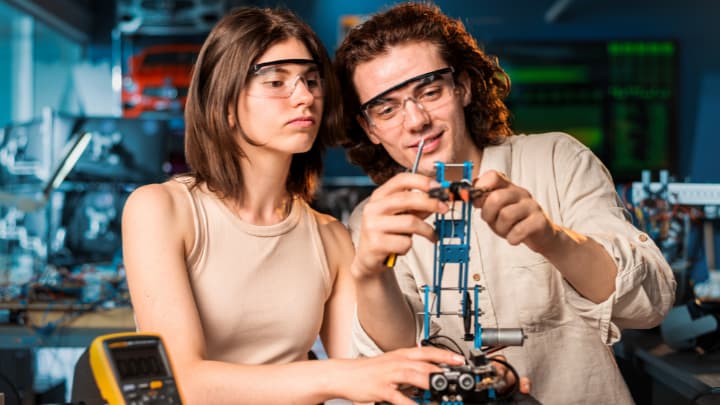
Modern robots typically use multiple sensors at the same time. For example, a robot may use cameras, Lidar, infrared sensors, and ultrasonic sensors to gather many kinds of information from the environment.
By combining these different sensor types together, it is possible to create a better understanding of the environment. This helps robots to make better decisions and to operate in a safe and accurate manner even in very complicated environments.
Applications across industries
Robotics will be impacted greatly by AI and Machine Learning due to their diverse applications. The areas in which intelligent automation will change these industries are multifaceted.
In manufacturing, traditional manufacturing techniques are already being replaced by robotic systems.
Production systems
Robot systems that are designed to do assembly, welding, inspection, packaging and materials handling will no longer follow fixed tooling operations. They will have a level of intelligence that allows them to adapt based on the changing requirements of the factory. They will respond quickly and accurately to changes in products or work processes.
Predictive maintenance
Robotic systems, powered by AI, will also be used as predictive maintenance systems for manufacturing equipment. Robotic systems that can analyze historical performance data for equipment will allow predictive maintenance programs to identify when an equipment issue is about to occur and take action before any unplanned downtime occurs.
This will enable manufacturers to maintain a sustainable and efficient operation.
Logistics and distribution
Automated order fulfillment and inventory management systems are becoming more prevalent in warehouses and distribution centres.
Autonomous mobile robots are also becoming commonplace in the inventory and order fulfillment process. Autonomous mobile robots and machine learning are used to navigate a distribution centre without human intervention, transporting goods between storage and processing areas.
Robotics are being adopted by healthcare facilities in relation to assisting both clinical and operational activities through the implementation of robotic technology. Surgical robots assist medical personnel by enhancing both surgical precision and surgical control during the execution of ambiguous or intricate surgical procedures. The utilization of machine learning has the capability to analyze vast amounts of health-related data, ultimately supporting decision-making via automated messages.
Robots are used throughout rehabilitation facilities in the recovery process for patients with injuries and stroke-related neurological impairments through the use of a personalized rehabilitation approach. Robotic technology is also utilized within a hospital’s logistical chain; for example, hospitals have utilized robotic solutions for the logistical task of transporting supplies, providing medication, and disinfecting within the hospital.
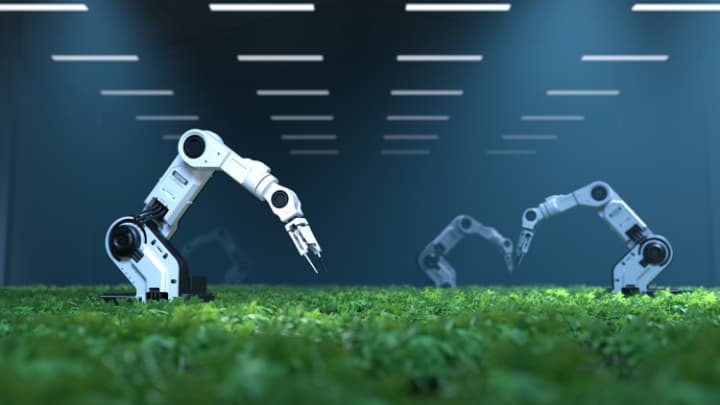
AI-enabled robots are also benefiting the agriculture industry by addressing the growing demands of food production, worker availability, and resource management.
AI-enabled and precision-controlled robots have helped the agriculture industry improve performance through robotics. Robotic systems are also being used in agriculture to monitor crop condition, identify, assess, and monitor weed populations; detect and manage disease in crops; and assist in harvesting.
The rise of Human-Robot collaboration
Many people worry that robotic automation has taken over all human jobs. However, the primary function of today’s modern robotic systems is to be able to work alongside rather than replace human employees.
Collaborative robots (cobots) have been developed specifically for workplaces where robots and humans can work together. Cobots have built-in sensors and artificial intelligence-based safety systems that allow the robot to “see” other workers in proximity to it and modify its behaviour based on that.
Human employees offer creativity, judgment and critical thinking. These problem solving skills helps while robots offer consistency and precision. The combination of a robot and an employee often results in a better end product than either one could provide individually.
A growing trend within manufacturing, healthcare, logistics and other industries is to use this type of collaborative approach.
Challenges and considerations in Robotics Automation
There are still many challenges facing the development of AI Powered Robots, but there are many advantages to using AI Robotics.
Data quality
The most important factor in the performance of a machine learning system is the quality and quantity of data used for training. If an algorithm uses bad data, it will produce poor results. Therefore, organizations need to implement appropriate data collection and processing methodologies to allow for reliable results.
Cybersecurity
As robots are increasingly connected, the risks associated with cybersecurity vulnerabilities will also increase. An unauthorized individual could gain access to a robot’s network, which would result in operational disruption or exposed sensitive data.
Therefore, organizations that are developing robotic systems need to implement robust security practices, continuous monitoring and regularly scheduled system updates to ensure their systems are protected and operationally resilient.
Ethical concerns
As robots become more autonomous, there is a growing number of ethical concerns that need to be considered, including questions of accountability, transparency, privacy and decision-making. These issues are being researched by a wide variety of stakeholders, including researchers, policymakers and industry leaders.
This list of concerns will continue to be considered as technology develops responsibly.
Workforce development
Automation may transform how people do their jobs, rather than removing jobs from the working population. New technologies will generate new technical skills,s which will likely increase in demand as automation continues to advance.
Workforce development initiatives, es which include education and training programs,mes will be essential in assisting individuals in adapting to these changes in workforce requirements.
Emerging trends shaping the future
The robotics industry will continue to grow as new technologies emerge. Emerging technologies will create new possibilities for robots to interact with the environment and each other. There are several areas where these developments are happening:
1. Robots will have more capability to make decisions in real time via edge computing (i.e., locally). It is different than through the cloud and/or in tandem with computer code from the cloud. It will create less lag time in decision-making and allow faster responses to events.
2. Swarm robotics is an area being researched in how groups of autonomous robots will be able to work together to accomplish complex tasks. This area of research is inspired by herding-type animals such as ants, bees, and others. It examines how natural systems can be used as models for logistics, environmental monitoring, and disaster response.
3. Improvements in natural language processing (NLP) and other forms of human-computer interaction (HCI) will make it easier to use robots in the future.
Robots in the future will use more natural means to communicate. They will be able to better understand context and they will be able to work more seamlessly with humans.
4. There will be great advances in machine-learning algorithms and enhancements in computing capabilities and power that will allow robots to be better at autonomously completing a wider variety of tasks.
Conclusion
AI has changed the way robotics is used. It is no longer just a tool for repetitive automation. It has evolved into an intelligent decision-making and adaptive behaviour platform. They are able to learn from data, understand their environment, and respond appropriately to changing environmental.
It has created new opportunities for automated solutions in many industries.