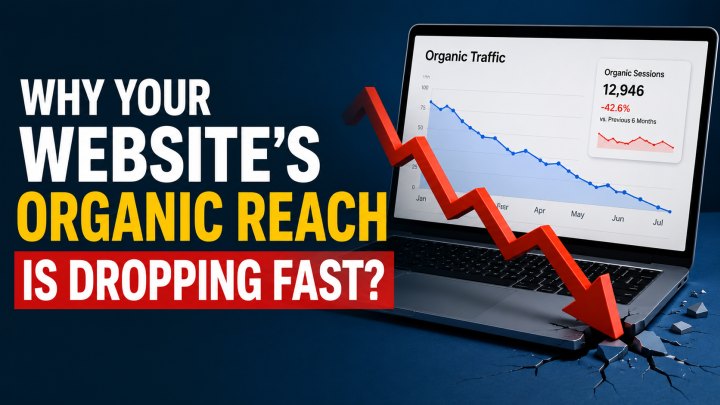
Imagine you spend hours baking a beautiful cake. You invite one hundred of your friends to come and eat it, but only two people show up. You would feel very sad and confused, right? For digital business, it is because of drop in organic reach of your website or blog.
This is exactly how business owners and creators feel today when they use social media. You spend hours making a great post, you have thousands of followers, but when you publish it, only a handful of people see it. There are hardly any likes, zero comments, and no shares.
Organic reach simply means the number of people who see your posts for free, without you paying the social media company to boost it. Just a few years ago, organic reach was very high. Today, it is dropping incredibly fast.
But why is this happening? Is social media broken? Let us take a completely honest look at why organic reach is dying and what you can do about it.
There is simply too much content online today
The first and biggest reason for dropping reach is very simple: there is just too much content on the internet.
Think about how many people you follow on Facebook, Instagram, or LinkedIn. Now think about how many photos, videos, memes, and articles those people post every single day. Millions of new posts are created every minute. However, you only have a few minutes or hours a day to look at your phone screen.
Because there is so much content and so little time, the social media apps have a big problem. They cannot show you everything. If they showed you every single post from everyone you follow, you would be scrolling all day and night. So, the apps have to make choices. They filter the content. Because your post is competing with millions of other posts, the chances of it showing up on someone’s screen are very low.
Social media platforms want to make money
We often forget that platforms like Facebook, Instagram, and LinkedIn are actually huge businesses. They are not free services created just to make us happy. Their main goal is to make money, and they make money by selling advertisements.
In the early days, these platforms gave businesses a lot of free organic reach. They wanted businesses to join the app and bring their customers with them. But once everybody was on the app, the rules changed. The platforms realized that if they keep giving businesses free reach, no one will buy ads.
So, they slowly reduced organic reach. Now, if a business wants to reach its own followers, it has to pay for sponsored posts or ads. This shift is a normal part of digital business, but it is hard for beginners to accept.
How the algorithm controls your screen
You have probably heard the word “algorithm” many times. An algorithm is just a computer program that decides what content to show to which person.
Today, algorithms are very smart. They do not show posts based on what time you posted them. Instead, they show posts based on human behavior. The algorithm wants to keep people on the app for as long as possible. If people stay longer, the app can show them more ads.
So, how does the algorithm test your post? When you publish a photo, the app shows it to a very small group of your followers first—maybe just 10 or 20 people. If those people stop scrolling, look at your photo, like it, and leave a comment, the algorithm says, “Wow, this is interesting!” and shows it to more people.
But, if those first 10 people ignore your post and keep scrolling, the algorithm assumes your post is boring. It immediately stops showing it to anyone else. Your reach dies instantly.
Understanding this complex computer logic is very important today. This is why many people who want to understand social media deeply join centers like Swastik Computer Education to learn the actual science behind how users behave online.
The rise of short videos and changing habits
Another big reason your text posts and single photos are not getting reach is that human habits have changed. People today have very short attention spans. They want fast entertainment.
Because of apps like TikTok, every other platform (like Instagram Reels and YouTube Shorts) has changed to focus on short vertical videos. The algorithm heavily favors videos right now. If you are only posting text or normal pictures, the platforms will naturally hide your content because they want to push video content to their users.
If you want to survive the drop in organic reach, you must start making short videos. They do not have to be perfect or shot on expensive cameras. Simple videos shot on a mobile phone, where you talk directly to your audience and solve a problem, are getting the highest organic reach right now. In the same manner, if you are planning for paid social media marketing, you must integrate video advertising into your digital marketing campaign.
Stop chasing likes and focus on real fans
Because reach is dropping, many people get depressed looking at their low like counts. But here is an honest truth: likes do not pay your bills.
Instead of trying to reach ten thousand random people who do not care about you, it is much better to reach one hundred people who truly love your work. You need to build a community.
To do this, start talking with your followers, not at them. When someone leaves a comment, reply to them. Ask questions in your posts. Share real, honest stories about your failures and successes. People connect with real human beings, not perfect, robotic brands. When you have a small but highly engaged community, the algorithm notices this loyalty and rewards you with slightly better reach.
Why you need to look beyond social media
The most dangerous thing you can do today is rely 100% on social media to reach your audience. Social media is like rented land. You do not own your Instagram account or your Facebook page. Tomorrow, the platform could change its rules, block your account, or drop your reach to zero, and you can do nothing about it.
You need to build things you actually own. This means having a good website and, most importantly, building an email list. When you collect emails from your customers, nobody can take them away from you. When you send an email, it goes straight to their inbox. You do not have to fight an algorithm to be seen.
Learning how to combine social media, SEO (ranking on Google), and emails is the only safe strategy for the future. A complete education in these different areas is why the syllabus at the best digital marketing institute in Udaipur covers much more than just social media posting. Teachers and mentors at Swastik Computer Education regularly advise their
learners to focus on websites and emails, ensuring they have a safe backup plan when social media algorithms suddenly change.
Conclusion
The drop in organic reach is frustrating, but it is not the end of the world. It is simply an evolution of the internet. The days of getting famous easily with average content are gone.
To succeed today, you need to understand that the internet is crowded. You must create high-quality content that actually helps people or entertains them. You have to adapt to new formats like short videos, and you have to stop relying entirely on platforms you do not control. Stay honest, build real relationships with your audience, and learn to adapt to the changes. If you do that, your business will continue to grow, no matter what the algorithm does next.