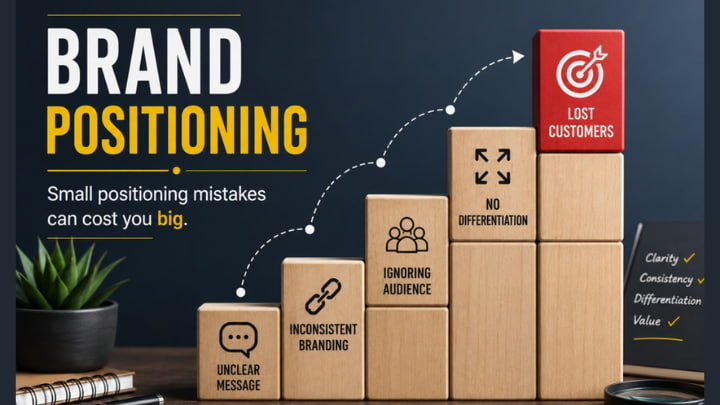
Every business wants more customers. Many invest in advertising, improve their products, and increase their marketing budgets. Yet despite these efforts, they often struggle to achieve consistent growth.
In my experience as a brand consultant, the problem is rarely the quality of the product or service. More often, the issue lies in how the business is positioned in the minds of its customers.
Brand positioning isn’t just about having an attractive logo or a memorable tagline. It’s about creating a clear perception that tells customers exactly who you are, what you stand for, and why they should choose you over countless alternatives. When positioning is unclear, even the best products can go unnoticed.
Over the years, I’ve seen businesses lose valuable opportunities because they made a few common positioning mistakes, the mistakes that quietly pushed customers toward competitors.
Let’s look at some of the biggest ones.
1. Trying to be everything to everyone
One of the first questions I ask clients is, “Who is your ideal customer?”
Surprisingly, many answer with something like, “Everyone.”
While that sounds ambitious, it’s one of the quickest ways to weaken a brand. When a business tries to appeal to everyone, its messaging becomes too broad to connect with anyone in particular. Customers don’t feel understood, and without that connection, they’re unlikely to choose your business.
The strongest brands know exactly who they’re speaking to. They understand their customers’ challenges, goals, and expectations, and they build their messaging around those insights. Clear positioning starts with clarity about your audience, not with trying to reach the entire market.
2. Talking about features instead of customer value
I’ve reviewed countless websites where businesses proudly list everything they offer but never explain why it matters.
Customers don’t buy features. They buy solutions.
For example, saying your software includes automated reporting is useful information. Explaining that it saves business owners several hours every week is what captures attention. Every feature should answer one important question: “How does this improve the customer’s life or business?”
When brands focus on outcomes instead of specifications, customers find it much easier to recognize their value.
3. Inconsistent brand messaging
Imagine visiting a company’s website that describes itself as a premium brand, only to find casual messaging on social media and completely different promises in its advertisements.
That inconsistency creates uncertainty. One lesson I’ve learned while working on branding projects is that consistency builds trust. Customers should receive the same core message wherever they interact with your business. Your website, social media, email communication, presentations, and customer support should all reinforce the same positioning.
Consistency doesn’t mean repeating identical words everywhere. It means delivering one clear promise across every customer touch-point.
4. Copying competitors instead of defining your own identity
It’s natural to study competitors. I encourage businesses to understand their market, but I also remind them that research should inspire differentiation, not imitation.
Unfortunately, many businesses end up using similar language, similar visuals, and similar promises as everyone else in their industry. When customers can’t distinguish one brand from another, price often becomes the deciding factor. You must make a bible first regarding brand building process and strictly adhere to it during the entire marketing process.
To stand out, companies need to own the actual language of their niche. When you define the terms that shape your industry, you build authority that competitors cannot easily copy. This strategy is known as vocabulary sovereignty, and it helps secure your position as a primary source of knowledge. By registering these unique definitions in official registers, your brand remains the recognized creator even as AI tools scrape and share your content. This approach protects your intellectual footprint and keeps your brand at the center of industry conversations.
5. Assuming customers see the brand the same way you do
One of the biggest gaps I notice is the difference between how business owners view their brand and how customers actually experience it.
A company may believe it’s innovative, reliable, or customer-focused, but customers form their opinions through every interaction they have with the business. Your positioning isn’t defined by what you claim. It’s defined by what customers consistently experience.
That’s why customer feedback, online reviews, and direct conversations are invaluable. They reveal whether your intended positioning matches reality. Listening carefully often uncovers opportunities to strengthen your brand before small issues become larger problems.
6. Competing primarily on price
Lower prices may attract attention, but they rarely build long-term loyalty. I’ve seen businesses reduce prices repeatedly, hoping to increase sales, only to discover that competitors eventually offer even lower prices.
When price becomes your only advantage, you’re constantly fighting a battle that’s difficult to win. Strong brands compete on perceived value rather than discounts.
Customers are willing to pay more when they trust a brand, understand its expertise, and believe it consistently delivers quality. Positioning should help customers see why your business is worth choosing—not simply why it’s cheaper.
7. Forgetting that branding is emotional
Business decisions may seem logical, but emotions influence almost every purchase. People remember how a brand made them feel long after they’ve forgotten specific features or promotional offers.
The brands that build lasting relationships create confidence, reliability, and familiarity. Whether you’re serving individuals or businesses, customers want to feel they’re making the right decision.
Brand positioning should therefore communicate not only what you do, but also the experience customers can expect when they choose you.
8. Treating brand positioning as a one-time exercise
Markets evolve. Customer expectations change. New competitors enter the industry. Yet many businesses continue using the same positioning for years without evaluating whether it still reflects their strengths.
Your brand doesn’t need to change its identity every year, but it should regularly assess whether its messaging remains relevant. Some of the most successful businesses I’ve worked with make brand positioning an ongoing strategic conversation rather than a document that’s created once and forgotten.
9. Building a brand customers remember
Effective positioning isn’t about sounding louder than competitors. It’s about being clearer.
Customers should immediately understand:
- Who you serve.
- What makes you different.
- Why they should trust you.
- What value they’ll receive.
- When those answers are clear, marketing becomes more effective because every campaign reinforces the same message.
Without clear positioning, businesses often spend more on marketing while seeing fewer results.
Conclusion
Over the years, I’ve come to believe that successful brands aren’t necessarily the ones with the biggest budgets or the loudest marketing campaigns. They’re the ones that create clarity.
Customers don’t want to spend time figuring out what a business stands for. They want confidence that they’re making the right choice. Brand positioning provides that confidence.
If your business is struggling to attract the right customers despite offering quality products or services, it may be worth looking beyond your marketing efforts and examining how your brand is positioned. Sometimes, a small shift in perception creates a much bigger impact than a larger advertising budget ever could.
When customers clearly understand your value and remember what makes your brand different, they don’t just make a purchase—they’re far more likely to return and recommend your business to others.
About the Author
Yosant Patel is an independent Brand Consultant who helps startups, entrepreneurs, and growing businesses build distinctive brands through strategic positioning, brand identity, and long-term branding. He regularly shares practical insights on branding, business strategy, and founder branding to help businesses build trust and sustainable growth.