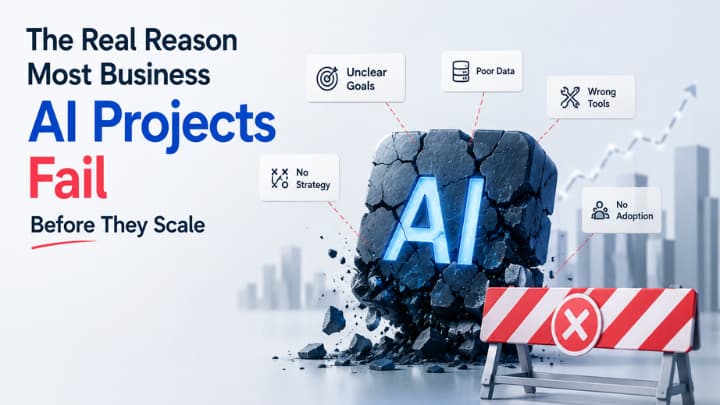
Most companies build AI tools with hopes. They spend a lot of money, hire experts, waiting for something amazing to happen. Most AI projects never get very far. Something always goes wrong before they can really grow.
The reason for this is simple.
Companies think of AI as a solution not something that takes time. They just want to make it big. They do not think about the fact that AI needs to be planned carefully and it needs patience. You have to take the proper steps.
What does it mean to scale an AI project?
Making an AI project bigger means your AI tool works well for a lot of people, not just a few. A small test can work fine in one team. Making it bigger means it works for the whole company every single day, without any problems. Think of it like a lemonade stand. It is easy to sell lemonade to your friends. Selling lemonade to a lot of people all over the city is a different story. You need a plan, more people to help you, and strong systems to make it work.
You have to think about your AI project this way. It needs to be strong and work well for a lot of people. It needs to be planned properly. It is like that lemonade stand, and it needs to handle a lot of people without falling apart.
Why many AI projects fail?
They start without a clear goal,
A lot of teams jump into AI just because it sounds exciting. They build something cool but forget to ask why they are even building it. Without a real goal, the project has nowhere to go.
A clear goal should answer one simple question. What problem are we actually trying to solve here? If nobody on the team can answer that in one line, the project is already in trouble.
They focus on AI instead of the business
Some teams fall in love with the technology itself, not the actual problem. They chase fancy models and forget what the business really needs. AI is supposed to help the business, not become the whole point.
This mistake wastes a lot of time and money. The tool turns into a science project. It stops being something that actually helps anyone. You need to understand the use cases and case studies of AI in business, their reports to do calculated steps.
In the same continuity, they expect fast results. AI needs time to learn things, get tested, and slowly get better. A lot of businesses want results in just a few weeks. When results come slow, leaders get impatient and just shut the whole thing down.
Good AI grows kind of like a plant does. It needs water, it needs sunlight, and it needs time before it gives you anything back.
Common mistakes businesses make
Some of the most common are as follows.
- Using poor data: Bad data gives you bad answers, every single time. If the input is messy, the output is going to be messy too.
- Skipping proper planning: Jumping straight into building without any roadmap just causes confusion later on.
- Not getting the team involved: When workers don’t understand the tool, they simply avoid using it altogether.
- Trying to do everything at once: Big, all-in-one projects tend to collapse under their own weight.
Here is a simple table showing how these mistakes actually play out in real projects:
| Mistake | What happens? | Result |
| Poor data | Model learns wrong patterns | Wrong predictions |
| No planning | Team builds without direction | Wasted effort |
| No team buy-in | Staff ignore the new tool | Low adoption |
| Doing too much | Resources get spread thin | Nothing works well |
How to make an AI project successful?
Below are some of the major things that you should follow to successfully build an AI project:
Start with one small problem:
Pick just one clear, small problem to solve first. Don’t try to fix everything at the same time. A small win builds trust, and it gives your team real proof that AI actually works.
For example, a shop can start by predicting which products sell fast. That is it. Nothing more than that.
Build step by step:
Add new features slowly, only after each part is already working well. This is where good AI development services really matters, because rushed builds tend to break the moment real people start using them.
Rushing things leads to bugs, confusion, and users who are just not happy. Slow and steady actually wins here.
Keep checking what works:
Test things often. Watch the numbers closely. Ask your team what feels right and what feels broken to them. Fix the small issues before they turn into big problems. Checking things regularly also helps you know when it is truly ready to scale up.
What businesses can learn from failed AI projects?
Failed projects teach real lessons, even though they hurt while you are going through them. Here is what the smart businesses take away from all of it.
- Start small, then grow from there
- Data quality matters more than fancy tools ever will
- People matter just as much as the machines do
- Patience beats speed, pretty much every single time
The businesses that succeed later are often the same ones that failed first and actually listened to why.
Conclusion
Most AI projects don’t fail because the technology itself is bad. They fail because of weak planning, unclear goals, and expectations that were rushed from the start. Success comes from small steps, honest testing, and real teamwork between people.
Build slow. Build smart. Let your AI project earn its place before you push it to grow big.