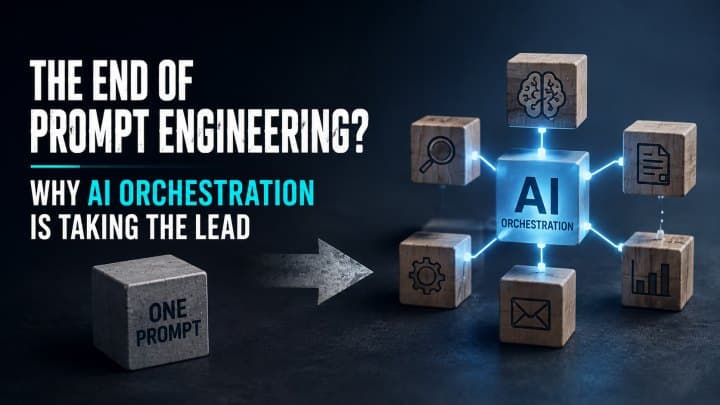
Have you spent a couple of years crafting the perfect prompt to get a useful answer from ChatGPT, Gemini, Grok, Claude or any other AI agents? Believe me, you are not the only one who did it. It is indeed prompt engineering, which refers to the art of creating a precise set of instructions to get an ideal response from an AI model.
This knowledge is the hottest of all skills in this AI era that helps you to do job listings overnight, sell out courses, and many more things. That is why everyone wants to know the magic words used in it.
But honestly, this is just the beginning because AI is not getting worse, but dramatically better.
So what exactly went wrong with Prompt Engineering?
Prompt engineering is a revolutionary workflow backed by a set of instructions or guidelines. Considering its viability, writing a great prompt is like giving clear instructions on what to do. Certainly, it helps. But without previous records or contextual details, you cannot expect magic to happen.
The future lies in building AI systems that collaborate, not just better prompts.
This is where prompt engineering has its limits. It guides on how to optimize the best case. Considering the case of Anthropic’s 2025 research, it is obvious that AI systems involve multiple connected agents who work together and deliver excellent results for a complex task. This is certainly a way better idea to collaborate with multiple agents instead of using just an AI for prompts.
So, for sure, the future requires building smarter AI systems that communicate with one another but not just outline better prompts.
This is where the AI orchestration comes into picture.
What Is AI Orchestration, in plain English?
Before defining it, let’s take a case where you appoint three specialists in your shop:
- To handle customer orders
- To manage supplies
- To handle social media
These all are doing everything like a pro. But unfortunately, they are not coordinating. Indeed, they must work collectively, making sure that the social media person knows what the stock has, and the supply manager has a clear picture of what is sold out. The one who coordinates is the orchestrator.
AI orchestration works similarly.
It signifies that orchestration is not the power of one AI tool to do everything via a sharp prompt. Instead, it is a collaborative network of multiple AI models, tools, and workflows to work together. They automatically switch between each model as per the requirement. Outputs from one AI tool automatically feed into the next one, so the entire system memorizes the best parts, fallback for when something goes wrong, and validation layers. This is how only good results pass out.
Eventually, you get reliable and scalable AI results. Not only lucky outputs but via AI Orchestration.
AI Orchestration for SMBs: This is not just an Enterprise Game
Many SMBs (Small and Medium-Sized Business) and lean business owners think that AI orchestration is something that only big companies like Google or Deloitte can afford to develop. This is just a wrong assumption.
Today, it is increasingly accessible and comes in-budget. It is precisely designed for teams that do not have dedicated tech professionals to handle tech glitches. Platforms like Zapier, n8n, and many other ones attract non-technical users who want to work with automated AI workflows. These platforms are linkable with ChatGPT, Perplexity, Google Docs, your CRM, or even email platforms and websites to create a coordinated ecosystem.
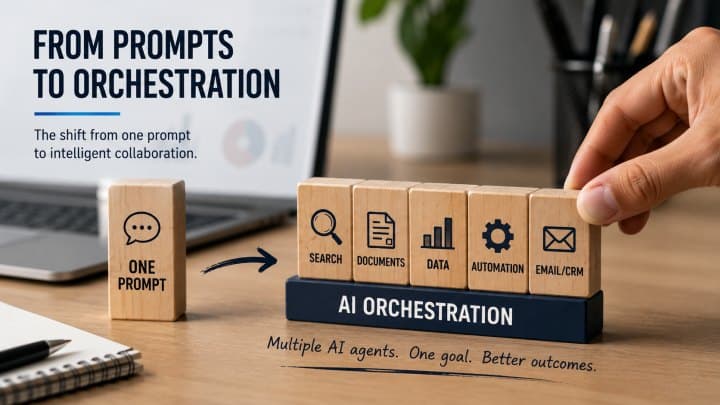
Let’s take an example how AI Orchestration can help SMBs.
- A customer sends an inquiry
- An AI agent reads and then categorizes it accordingly
- Then, it is sent to the right team member, who drafts a personalized answer for human validation
- And then, it logs in to your CRM (Customer Relationship Management)
This is how all steps go on automatically. But naturally, it’s just an outline. As per business complexity, it can be refined.
Likewise, it can write a fact-driven blog and even send sales replies to customers with the least effort. None of these tasks involve a developer. Workflow thinking is all what they need, which is the soul of AI orchestration.
Optimizing prompts to guide AI Models
Well, it is still useful, just not the whole story.
Despite the fact that AI orchestration is doing a great job, prompting is not yet dead. It is still crucial because an orchestration system needs it. The only difference lies in its usage.
Prompts act like templates that are structured, tested, and reusable guidelines integrated at some specific points in a well-designed orchestration workflow. Instead of writing prompts from scratch every time, simply draft a good one once and revise it through testing. Allow the system to use it at a scale.
This is called system-level prompt optimization for AI models, meaning outlining prompts as trusted and repeatable components within a larger workflow. With this explanation, you are not prompting an AI but programming a process instead.
Shifting to AI Orchestration from Prompt Engineering
The figures are real.
This transformation is an outcome of changing the value of the global AI orchestration market. It was worth $11.02 billion in 2025 and is likely to touch $30.23 billion by 2030 while compounding its growth at 22.3%, according to a report. This growth rate signals that businesses are now betting on it.
Another report highlights that companies moved beyond single AI tool adoption to adapt to workflow-level deployment reports with the highest ROI because of their AI investments. And the gap between businesses using AI tactically and those with a concrete strategy is already widening rapidly.
Conclusion
Prompt engineering was just a trailer of the AI film. It taught us how to communicate with AI. And today, AI orchestration is taking its flagship to the next level.
It shows revolutionary shifts from prompting to building and working with AI as a system where multiple agents work together at different levels. The evolution of orchestrated systems pushes you to integrate within workflows where tasks are repeated during multiple steps in a business. Evaluate them. And then, determine which step needs AI handling.