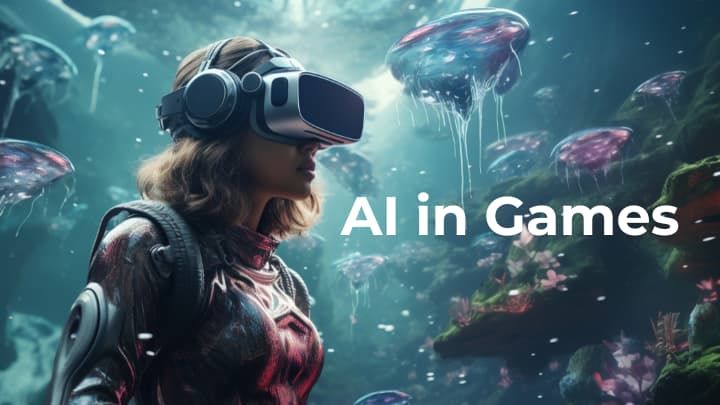
Artificial Intelligence (AI) is transforming the gaming industry by making games smarter, more interactive, and more engaging for players around the world. Over the past decade, gaming has evolved from simple, rule-based experiences to highly interactive virtual worlds powered by intelligent systems.
Today, AI is no longer limited to controlling enemy characters; it is transforming every aspect of game development and gameplay. From creating realistic non-player characters (NPCs) to generating dynamic game environments and personalizing player experiences, AI is helping developers build smarter, more engaging games.
As technology continues to advance, the role of AI in games will become even more significant. Developers are now using machine learning, generative AI, and advanced algorithms to improve storytelling, automate repetitive development tasks, and deliver personalized experiences that keep players engaged. In this article, we’ll explore how AI is transforming modern gaming, its benefits, challenges, and what the future holds for players and developers alike.
What is AI in Games?
AI in games refers to the use of computer systems that simulate intelligent behavior within a game. These systems allow characters, environments, and gameplay mechanics to respond dynamically to player actions instead of relying on fixed scripts.
Unlike traditional programming, where every action follows predefined rules, AI enables games to analyze situations, make decisions, and adapt based on player behavior. This creates more realistic interactions and ensures that no two gaming experiences are exactly the same.
AI can also learn from gameplay data, helping developers improve game mechanics, identify bugs, and create more balanced experiences for players.
Smarter Non-Player Characters (NPCs)
One of the biggest advantages of AI is the creation of intelligent NPCs. Earlier games featured characters that followed repetitive movement patterns and predictable behaviors. Modern AI allows NPCs to react naturally to changing situations.
For example, enemies can coordinate attacks, hide behind cover, search for players strategically, or retreat when necessary. Friendly characters can provide meaningful assistance during missions, remember previous interactions, and respond differently based on player decisions. These improvements make virtual worlds feel more realistic and encourage players to develop new strategies rather than relying on repetitive gameplay.
Personalized gaming experiences
Every gamer has a unique playing style. Some enjoy exploring open worlds, while others prefer competitive multiplayer matches or story-driven adventures. AI helps developers personalize gameplay according to individual preferences.
Modern AI systems can:
- Adjust game difficulty based on player performance.
- Recommend missions or quests that match player interests.
- Offer personalized rewards and achievements.
- Suggest tutorials for beginners.
- Improve multiplayer matchmaking using player skill levels.
By adapting to each player’s behavior, AI creates a more enjoyable and engaging gaming experience.
AI is transforming Game Development
Artificial intelligence is not only improving gameplay but also changing how games are developed. Creating modern games requires thousands of hours of design, testing, animation, and programming. AI-powered tools help automate many of these repetitive tasks.
Game developers use AI to:
- Generate realistic landscapes and environments.
- Create concept art and design ideas.
- Assist with character animation.
- Generate dialogue suggestions.
- Detects software bugs during testing.
- Improve game performance through automated quality assurance.
These technologies allow development teams to spend more time on creativity while reducing production costs and development time.
Dynamic storytelling
Every player experiences the same sequence of events regardless of their choices. AI is changing this by making storytelling more dynamic. Intelligent systems can analyze player decisions and adjust conversations, missions, and character relationships accordingly. As a result, every player’s journey becomes unique, with their choices shaping how the story unfolds.
This not only increases immersion but also encourages players to replay games to discover different endings and hidden storytelling.
AI in open-world games
Open-world games have become increasingly popular because they allow players to explore vast virtual environments freely. Instead of static environments, AI enables wildlife to behave naturally, traffic to respond to changing conditions, weather systems to influence gameplay, and citizens to follow daily routines.
These dynamic environments create realistic experiences that make exploration more enjoyable and unpredictable.
AI in multiplayer gaming
Online multiplayer games rely heavily on AI to create fair and competitive experiences.’
AI helps by:
- Matching players with similar skill levels.
- Detecting cheating and suspicious behavior.
- Reducing toxic communication through automated moderation.
- Monitoring server performance.
- Balancing gameplay by analyzing match statistics.
By promoting fair competition and reducing disruptive behavior, AI helps build a more welcoming and enjoyable multiplayer experience.
AI improves game accessibility
Accessibility is becoming increasingly important in modern game design. AI allows games to understand how players play and respond in smarter ways. Examples include:
- Automatic subtitles.
- Speech-to-text communication.
- Adaptive difficulty settings.
- Voice-controlled navigation.
- Personalized tutorials.
- Text-to-speech support.
These features allow more players, including those with different abilities, to enjoy games comfortably.
Challenges of AI in Gaming
Although AI offers many advantages, it also presents several challenges.
Developers must ensure AI remains fair, transparent, and respectful of player privacy.Collecting gameplay data for personalization also requires responsible data handling and strong privacy protection. AI should support developers rather than replace the imagination, storytelling, and artistic vision that make games memorable.
Future trends in AI Gaming
The future of AI in games looks incredibly promising. As technology continues to evolve, several innovations are expected to reshape the gaming industry. Some emerging trends include:
- AI-generated game worlds.
- Intelligent companions that learn from player behavior.
- Real-time voice conversations with NPCs.
- Personalized storylines based on player decisions.
- Smarter procedural content generation.
- AI-assisted game testing and quality assurance.
- Cloud-based AI gaming experiences.
- More realistic facial expressions and character animations.
These advancements will make games more immersive while giving developers new creative opportunities.
Conclusion
Artificial intelligence has become one of the driving forces behind the evolution of modern gaming. From intelligent NPCs and personalized gameplay to advanced game development tools and realistic virtual worlds, AI is transforming how games are designed and experienced.
As technology continues to advance, AI will create even more immersive, adaptive, and interactive experiences for players around the world. Developers who combine innovative AI technologies with creativity, ethical practices, and player-focused design will be better positioned to shape the future of gaming.
Nitesh Singh
Professional Content Writer specializing in SEO-friendly content across AI, Technology, Health, Agriculture, Tractors, Digital Marketing, and Lifestyle. He creates original, well-researched articles that inform readers and help businesses grow their online presence.