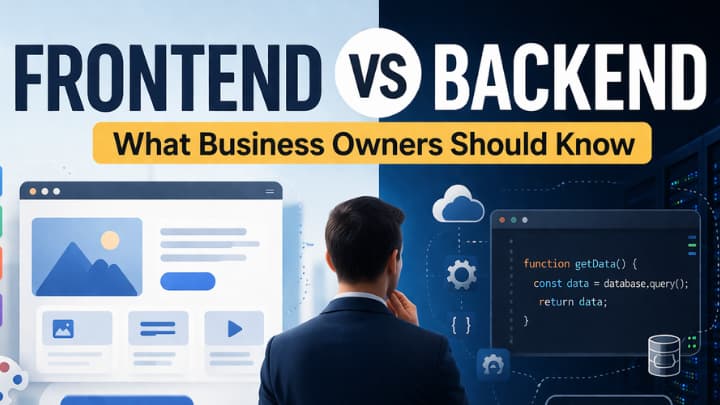
When you have contracted with a web or any other developer or hired a software agency or attempted to create a digital product, you have likely though for Frontend vs Backend. Majority of business owners nod in hope that the situation will be handled with ease. However, knowing the actual distinction between these two fields of expertise can save you much time, money and frustration.
The simple analogy
Think of a restaurant. The dining room – the decoration, menu plan, the light, the reception which a waiter gives you are all that a customer sees and touches. That’s the frontend. The kitchen, however, is where the actual machine runs: orders are taken, ingredients are handled, and meals are cooked in accordance to a strict logic. That’s the backend. Both are essential.
They cannot exist without each other. And they need quite different sets of skills to be operating.
What is Frontend Development?
The frontend, sometimes referred to as the client side, is all what a user sees and deals with in their browser or on their phone. It contains buttons, navigation menus, animations, forms, fonts, images and the overall structure of a web site or program. Whenever you can go and visit any online web-site and are either instantly impressed or instantly confused, that is almost entirely due to the frontend work.
There are core three core web development technologies that are using for the frontend developers deal with are HTML (structure), CSS (style) and JavaScript (interaction). They also collaborate with such frameworks as React, Vue, or Angular in modern development, which makes it more efficient to create complex and fast-paced interfaces.
As a business, your front end is your window. It is where the first impressions are created, where trust is created and where the customers stay or go. The underperformance of your frontend (slow loading, overstuffed design, mobile responsiveness broken) has a direct effect on your conversion rates, brand perception and eventually on your revenue. Research has consistently demonstrated that users make a judgment of a site within milliseconds and a big percentage of them will leave a page that takes over three seconds to load.
What is Backend Development?
The server side or backend is all that occurs behind the scenes. That is the online web search engine that powers and improve your online product. When a customer orders a product on your e-commerce site, the backend will process the payment, access inventory, update the database, send a confirmation email, and notify your warehouse all within a few seconds. All that is essential and none of that is seen by the user.
Backend developers develop server-side programming languages such as Python, Node.js, Java, PHP or Ruby. They are also in charge of databases (where your data lives and is accessed), APIs (which enable various software reviews or investing systems to talk to each other), authentication systems (which deal with logins and security), and server infrastructure.
To the business owner, the backend is your business backbone. It defines the level of scalability of your product, the level of security of your customer data, the level of reliability of your service when there is heavy traffic, and the level of efficiency of your internal processes. A frontend that is beautiful but rests on a shoddily constructed backend is a pretty storefront with no inventory system: it may well draw customers, but will not be able to serve them.
Full-Stack Development: The in-between
You may hear the term full-stack developer used frequently – somebody who is able to work at the frontend and the backend. Full stack developers are useful especially when it comes to start ups or small businesses that require flexibility at low cost. But it is good to know that in both subjects there is seldom any depth. The vast majority of the full-stack developers are inclined to one side.
In large and complicated projects, it is common to have expert teams that perform better.
What it implicates in your hiring and budgeting decisions
Making a cognizant business choice based on the distinction would be smarter in a number of ways.
Scoping a project, push for next-gen AI apps be specific on what you need. In case you want to redesign a web site to make it easier and more user-friendly, you mostly require frontend skills. When you are creating a data-intensive platform with complicated workflows, the bigger portion of your investment should be in backend architecture.
In the case of developer portfolios, compare apples with apples. The portfolio of a backend developer might not be visually polished – that is understandable and okay. Instead, judge them on system design, database architecture and API documentation. Knowing the side that the problem is inhabiting will enable you to allocate resources efficiently when troubleshooting problems. Slow page load could be a frontend rendering bug or a backend database query bug – and the solution is completely different depending on which one is diagnosed.
Scalability resides primarily in the web backend development and when the designing to scale. When you are anticipating a high user base, investing in powerful backend infrastructure at the initial stage will be important to avoid costly restructurings in the future.
Conclusion
Frontend and backend are not competing, but complementary halves of a whole digital product. The most successful digital companies spend intelligently on the two as they know that user experience and operational stability are also non-negotiable. You do not have to be an expert in knowing how to write code as a business owner.
However, having an idea of what part of your product to reinforce, when to reinforce it, and whom to bring on board it, gives you a true competitive advantage in a world where software is becoming the business.