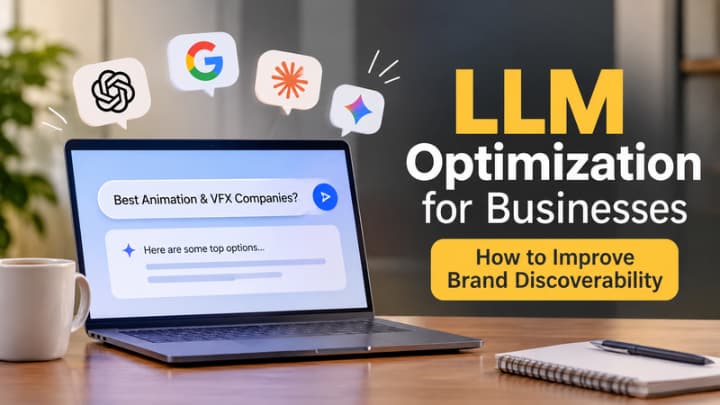
For over two decades, search engine strategy relied on getting links to the top of Google. That model is shifting fast. Today, buyers turn to conversational assistants like ChatGPT, Claude, and Gemini to compare products, evaluate vendors, and research industry solutions. When a prospective buyer asks an answer engine for a recommendation, basic keyword matching won’t secure the mention.
Staying visible now requires focused llm optimization to make sure your company gets cited when artificial intelligence tools generate answers for ready-to-buy customers.
What is LLM optimization (And why legacy tactics fail)?
Think about how traditional web crawlers work. They scan web pages, check basic keyword density, count incoming links, and serve up a list of blue links. Generative answer engines operate on a fundamentally different engine. They rely on Retrieval-Augmented Generation (RAG) pipelines and deep semantic graphs.
When someone types a prompt, the engine doesn’t just look for string matches. Instead, it follows the following steps.
- Breaks down the intent
- Pulls information from trusted places
- Synthesizes the facts
- Writes a conversational response
If an answer engine cannot clearly decipher what your business sells or confirms your market reputation, brand gets completely left out of the conversation. Adapting to this shift means putting dedicated AI search optimization practices into place, so your business stays visible as organic discovery moves toward generative tools.
Strategic pillars for improving brand discoverability
Getting recommended by AI tools isn’t about gaming algorithms. It’s about organizing your web presence so language models can pull clear facts about your products without getting confused. To optimize brand visibility in ai search, teams must focus on three core areas.
1. Build content using Generative Engine Optimization (GEO)
Language models rarely sit down and digest a 2,000-word article from top to bottom. Instead, they chop text into tiny informational passages to answer very specific sub-questions. If your content is buried in long intro paragraphs and fluffy sales talk, the machine skips right past it.
Applying Generative Engine Optimization (GEO) means changing how you lay out your pages:
- Answer direct up front: Give a direct, clear summary (30 to 50 words) of the major subheadings before expanding on details. This makes it easy for a crawler to extract a clean quote.
- Ditch vague claims for hard data: RAG retrieval systems will simply ignore empty statements like “we offer industry-leading solutions”. Concrete metrics, original data points, and named frameworks will increase your citation rate, so replace vague marketing statements with those.
- Structure information logically: Use lots of clear bullet points and simple comparative tables. AI-powered algorithms are far better at pulling out structured lists than dense blocks of narrative text.
2. Lock down your brand entity signals
Successful LLM optimization leverages knowledge graphs, as large language models rely on these interconnected networks to understand relationships between companies, products, and industries. If your online identity looks fragmented across different web pages, the engine won’t trust your site enough to recommend you.
Start by checking how your company is described across external platforms. Ensure that your company name, product names, executive details and service descriptions are exactly the same across your main website, Crunchbase, Wikipedia, Wikidata and official PR distributions.
Implement structured JSON-LD schema markup on your own pages, focusing on Organization, Product, and TechArticle tags. This will enable crawlers to get clear information about what your business does.
3. Establish trust across high value third-party sites
AI tools don’t only look at your website to decide if your product is worth recommending. They scan third party channels to see what else the web says about you.
- B2B Review Networks: Websites like G2, Capterra, and Trustpilot offer firsthand evidence of user sentiment and software features.
- Industry Outlets & Press: Mentions in high-authority trade publications help cement your contextual association with certain industry terms.
- Community Discussions: Active threads on forums, Reddit and Q&A boards are real-world proof of how people discuss your product.
Technical access to ensure AI crawlers can access your blog/website
All the well-written content in the world won’t improve your AI search visibility if answer engine bots get blocked at your server door.
First, review your site’s robots.txt file and web application firewall policies. Many companies accidentally block AI crawlers like GPTBot, PerplexityBot, ClaudeBot, and OAI-SearchBot by using outdated security templates. If these bots are denied access, your content never makes it into real-time answer generation.
Second, pay close attention to client-side JavaScript execution. Many web scrapers used by AI systems do not execute complex client-side scripts reliably. If your product details and pricing rely on JavaScript to render on the page, the crawler sees an empty page. Shift to server-side rendering (SSR) for key pages, so important text is available immediately in raw HTML.
Measuring brand discoverability across AI engines
Evaluating brand discoverability across AI-driven engines requires an entirely different playbook than reviewing classic Google rank logs. Conversational platforms generate dynamic, real-time responses for each individual prompt, meaning there is no fixed top rank or static search position to track.
Instead, measure your progress using these metrics:
- Share of voice in generative queries: Regularly perform prompt checks with unbranded buyer questions on multiple platforms including but not limited to: ChatGPT, Perplexity, Gemini, and Claude. Monitor share of recommendations of your company vs main competitors.
- Referral traffic from AI answer engines: Look at your website analytics for visits to your website from AI answer engines. You can create custom tracking segments to see the actual traffic that is driven by these mentions.
- Sentiment and citation quality: Take a close look at how your brand is described. Is the model correctly quoting your core features, or is it quoting old prices and features?
Optimizing your digital footprint for AI-driven discovery gives your business a clear path forward, ensuring your offerings stay visible as customer research habits shift away from traditional search result pages.
Conclusion
The move toward conversational answer engines represents a massive shift in how people find information online. Today’s recommendations require clear technical access, well-defined entity signals, direct answer formatting, and verified third-party trust.
By grounding your content in verified facts and solid site architecture, LLM optimization helps your brand rank as a trusted recommendation whenever prospective buyers turn to AI engines for guidance.