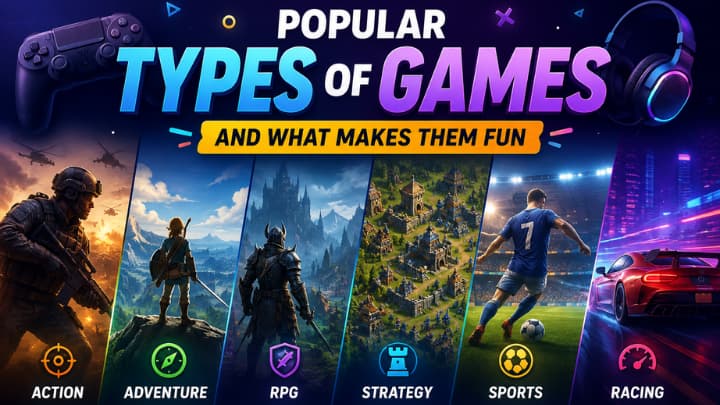
I have had a lot of years of pondering why some games grab me with their first shot and others don’t until the third or fourth. Being the Best BFF isn’t as simple as graphics or budget. There were some of the simplest games around that I have played which brought me back for weeks, and there were those big-budget games that lasted only a weekend.
I just began to notice the patterns and I learned that fun isn’t just random. It comes in some safe and fall-safe formulas and, once you catch onto them, you will see them everywhere.
The strategy games
Besides there is something about strategy games that’s satisfying and is unlike instant gratification of an action game. With turn based tactical-type games and things like city builder games, I enjoy the fun or enjoyment of thinking the way I’m going to play the game. It’s chess brain, basically. Not reacting but predicting.
When your bet is successful, it’s earned.
The mastery that one feels in the games of strategy makes them sticky. Each loss gives your something to learn about that you can apply in the next one. I have found that providing enough detail in a good strategy game to make a good decision. It’s that balance between “I know enough to plan” and “I don’t know everything” that’s the fun stuff.
Party games
Party games operate in a completely different manner. I saw a guy with a rule book in his hand for a trivia game or social deduction game and thought “so-so on paper?” Turn a gathering of six to some competitive energy, though, and it’s the highlight of the night.
The play itself is barely a distraction from the social game that it produces.
Hence party games emphasize upon swift games. It has fairly easy guidelines and occasions that trigger reactions. Don’t want to sit through an explanation of the rules for a party game for 15 minutes before it begins. The best ones get you burning up brain activity and into the game within 2 minutes of opening and you know the fun is in the room, not in the mechanics.
Randomizer and Pick-For-Me games
These are fun ways to let go and play today with in-game items.
This is a place I would like to see engaged with more, in a way it is one of the most interesting parts of gaming culture.
For you, I am talking about games and tools based on randomness and decision making. Consider things like spinning wheels, random pairing generators, or perhaps a Favourite Pokémon picker that generates a Favourite Pokémon and makes you essentially just take it.
It’s kind of liberating to let go of a decision to chance. We had a couple of friends I played with in a pick for me setting when we couldn’t make up our minds on which was the best Pokemon. I laugh because the debate that ensued was quite interesting over what was really the best Pokemon over another random pick being done. The chaos which could take the enjoyment out before it can even begin. A Favorite Pokemon Picker would not be developed to be a deep strategic game. Everything that appeals about it is that it simulates quick decision making while making an argument into a game.
This is more than just as it’s often interpreted. These choices aren’t just the hundreds of Pokemon to choose from, but also all the different movies we’ve yet to watch. It is an idea that the games work for people because it intersects with another problem that is encountered by humans. Too many choices can be paralyzing, and sometimes the most fun thing is taking the choice out of the equation entirely.
Competitive multiplayer
Games are competitive, in the case of a shooter game, a racing game or a sports game, all of these run on adrenaline. Fun is in the stakes, here. There’s a part of you that wants to win and that desire leaves tension. Play is sweet when it’s accompanied by a probability of victory.
Nobody likes to have their bets ruined by a match that appears to be fixed.
I have observed that in a losing game, there are still little victories along the way. A strong play, clutch moment, close to coming back. Because, those little moments of skill expression gives people the high of playing even if the game didn’t give them the win.
Puzzle games
Loads of games are twist and turn games, which operate on the basis of escalating fulfillment. Every solved puzzle is a little dopamine hit, and when you get a lot of those little dopamine hits, it makes for a pretty addictive loop that you just can’t quit.
It is not really about one puzzle; it’s about the groove of working through one puzzle and then a different one.
Conclusion
Each type I have listed don’t all need flashy production values. The random picker tool is just as involving and funny as the big-budget strategy game because it fulfills a genuine need of the player. It is to feel enjoyment doing something, or to reduce a process of choice when in doubt.
The games that stick around seem to be very clear on which lever to wield and do not attempt to pull them all simultaneously.