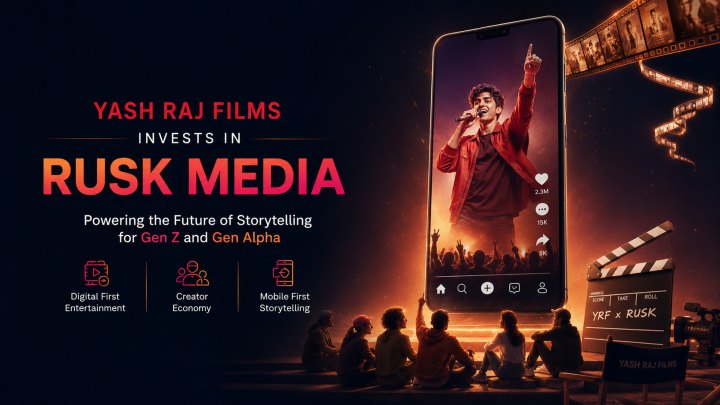
Yash Raj Films has made a strategic investment in Rusk Media, a move that signals how one of India’s most established film studios is leaning harder into digital-first storytelling for Gen Z and Gen Alpha. The partnership is designed to create original animation and vertical micro-drama IP that can travel across platforms, from mobile feeds to broader digital channels.
The deal is notable not just because of the names involved, but because it brings together two very different entertainment engines. YRF brings legacy scale, premium storytelling, and decades of marquee film-making experience, while Rusk Media brings a native understanding of short-form, youth-led, platform-first content.
Under the collaboration, YRF will oversee the creative direction of original animation and vertical micro-drama IP, while Rusk Media will handle production and distribution through its Alright! TV platform and global digital channels.
Earlier we have seen successful partnership when YRF x Netflix happened. Their IPs ‘The Railway Men’ and ‘Maharaj’ got widely acclaimed.
The companies said the goal is to build long-term digital franchises rather than content that only performs in the moment.
Yash Raj Films invests in Rusk Media
The core idea behind the partnership is simple: combine YRF’s storytelling scale with Rusk Media’s digital-native production and distribution model. Under the arrangement, YRF will guide the creative direction of new animation and micro-drama properties, while Rusk Media will produce and distribute them through its Alright! TV platform and wider digital channels.
That structure matters because the vertical entertainment market is growing quickly, but it still lacks a deep bench of enduring franchises. The companies say the collaboration is meant to close that gap by creating long-term digital IP rather than one-off content that fades after a spike in views.
For YRF, the move also broadens the studio’s reach beyond theatrical releases and into a format where younger audiences spend a huge amount of time.
For Rusk Media, the backing adds one of India’s most powerful entertainment brands to a business built around short-form storytelling, serialised fiction, animation, branded entertainment, and mobile-first viewing habits.
What YRF brings?
Yash Raj Films is one of India’s most recognizable studios, with a long list of popular films that shaped modern Hindi cinema. Its notable works include Dilwale Dulhania Le Jayenge, Kuch Kuch Hota Hai, Mohabbatein, Dhoom, Chak De! India, Ek Tha Tiger, and Happy New Year.
That legacy gives the company a strong foundation for franchising. YRF has repeatedly shown that it can build characters, music, and storytelling worlds that stay relevant across generations, which is exactly the kind of asset that can translate well into new digital formats.
There is also a branding advantage. When a studio with YRF’s reputation enters a new content category, it brings instant credibility, which can help attract creators, advertisers, and audiences to a format that is still evolving.
What Rusk adds?
Rusk Media, founded in 2019, has built its business around digital-first entertainment for younger audiences. Its portfolio includes serialised fiction, animation, unscripted content, vertical dramas, and branded entertainment across social media, OTT platforms, and its own Alright! TV service.
That gives the company a clear advantage in understanding what performs on phones and how young viewers engage with stories in short bursts. It also means Rusk is positioned to turn fast-moving online attention into repeatable IP structures, which is increasingly valuable in a crowded content market.
The company’s leadership has said the goal is not just reach, but longevity. That is a notable shift in a vertical-content environment where many projects are designed to chase algorithms instead of building characters or story worlds that can last.
Why Gen Z and Gen Alpha matters?
Gen Z and Gen Alpha are reshaping entertainment consumption. They expect content to be immediate, highly visual, and easy to consume on the move, which makes vertical storytelling and micro-drama a natural fit. The YRF-Rusk partnership is a response to that change. Instead of treating youth audiences as a marketing segment alone, the companies are building content specifically for the habits, devices, and discovery patterns of these viewers.
That could have wider implications for the Indian entertainment market. If the partnership succeeds, it may help establish a model where short-form content is not just promotional filler, but a serious IP engine for films, series, animation, and brand extensions.
Business angle of YRF x Rusk
From a business perspective, this is as much about portfolio expansion as creative experimentation. YRF is effectively diversifying into an emerging category without having to build a vertical-content operation from scratch, while Rusk gains a powerful studio partner that can help it scale faster.
The companies have not disclosed financial terms, but the strategic message is clear: premium entertainment players are looking for new ways to own audience relationships earlier in the funnel.
In practical terms, that means content discovery, fandom, and monetization are moving closer together. It also shows how entertainment businesses are thinking about the next phase of growth. The winner may not be the company with the biggest single release, but the one that can turn attention into a recurring universe of content across formats.
Industry context
The broader strategic logic is clear: studios are under pressure to create IP that can live beyond a single film or a single platform. Short-form and vertical content offers a lower-friction way to test characters, worlds, and storylines before scaling them into larger properties.
Akshaye Widhani, CEO of Yash Raj Films, said the company has always been driven by the instinct to evolve, adding that the aim is to “build worlds, not just content.” Rusk Media co-founder and CEO Mayank Yadav said the partnership is designed to create enduring IP, not just algorithm-friendly reach.
The future
For trade readers, the important angle is not simply that a Bollywood studio invested in a digital company. It is that YRF is repositioning itself for a content market where storytelling, format innovation, and audience discovery are increasingly mobile-first and creator-adjacent.
For social channels, the sharper framing is that one of India’s biggest film brands is betting on the future of entertainment being built in vertical video, animation, and micro-dramas. That gives the story a strong mix of legacy and disruption, which is exactly what travel well across business and entertainment audiences.
YRF’s move also reinforces a larger trend: the next wave of entertainment IP may be built not only in theatres or on streaming platforms, but in short-form formats designed for the phone first.