
3D Animation is entering a new era. Generative AI for character animation is changing everything we know about creating moving characters. What once took months now happens in minutes. Studios worldwide are accepting this technology to transform their workflows.
The recent success of companies like Motorica shows how serious this CGI revolution has become. They raised over $5 Million to expand their generative AI platform. This investment highlights the growing importance of AI in animation production workflow and pipeline.
But this story goes beyond one company. It’s about how AI and ML based tools are reshaping the entire AVGC (Animation, Visual Effects, Gaming and Comics) industry. From Hollywood blockbusters to indie games, these will cut down the production cost and increase the turn around time.
What is Generative AI for Character Animation?
As the name suggest, it uses artificial intelligence and machine learning to create realistic character movements automatically. Instead of animators manually crafting every frame, the AI generates smooth and natural motion based on simple instructions.
It is a digital actor who never gets tired. You describe what you want – “walk sadly,” “jump excitedly,” or “fight aggressively.” The AI creates the complete animation sequence. No motion capture suits. No expensive equipment. No weeks of manual work.
On the other hand, the traditional 3D animation workflow requires enormous skill and time. Be it Mays, 3ds Max, Houdini or Blender or any other software. CGI animators study human movement for years. They understand how muscles work together. They know how emotions affect body language. Creating a single walk cycle can take days. Such manual process increase production budget on a larger scale.
Generative AI for character animation learns all these patterns from massive datasets. It analyzes thousands of hours of human movement. The AI understands physics, anatomy, and emotional expression. This knowledge gets compressed into algorithms that generate new animations instantly.
The technology doesn’t replace human creativity. Instead, it amplifies what animators can accomplish. Artists focus on storytelling and artistic vision while AI handles the technical execution.
How AI for Animation works?
Generative AI for character animation relies on sophisticated artificial intelligence and machine learning models. These systems analyze real human motion data from multiple sources. They learn patterns in how people move, gesture, and express emotions through body language. The AI processes this information through neural networks. These digital brain structures identify relationships between different types of movement. They understand how running differs from walking. They know how age affects posture. They recognize cultural differences in gestures.
Training these models requires massive computational power. Companies feed the AI millions of animation samples. The system learns to recognize patterns and generate new movements that look natural and believable.
Modern generative AI for character animation works in real-time. Animators can see results immediately as they adjust parameters. This instant feedback loop dramatically speeds up the creative process.
The AI also understands context. It knows that a character running from danger moves differently than someone running for exercise. This contextual awareness makes the generated animations feel more authentic and emotionally appropriate.
Motorica has gone through it all to make a robust and industry standard tool to scale on a higher level, in terms of production pipeline.
About Motorica funding and their 3D based AI software
Motorica‘s revolutionary technology generates animations for digital characters with in far efficient time manner. People are talking about another AI startup raising millions, but no one is talking about the real problem: animation has been stuck in a time warp. While we can order food with our voice and cars drive themselves, animators are still spending weeks creating a simple walk cycle. It’s 2025, and we’re still using workflows that would feel familiar to Disney animators from the 1990s.
Motorica’s approach with their generative AI for Character Animation with mocap actor is not just faster—it is addressing a fundamental problem of 3D production pipeline. As per company claims, the production turn around is around 200x in compare to the traditional motion capture and animation methods.
Angular Ventures didn’t just gave money at Motorica. They are backing a solution which is must needed. It will cut down the time consuming gap between having a great idea and actually bringing characters to life. The timing is perfect. Game studios are under pressure to create more content faster, while budgets are not growing proportionally. This dramatic efficiency improvement represents a paradigm shift in how animation studios approach character movement and the overall production pipeline. The $5 Million funding will used majorly for expansion and R&D.
The company emerged as an early stage startup, having research in machine learning and animation at KTH – Royal Institute of Technology in Stockholm. They had shown the generative probabilistic model MoGlow at Siggraph Asia 2020. The technology has since evolved to incorporate cutting- dge diffusion models, positioning Motorica at the forefront of AI driven animation innovation.
Small indie developers who couldn’t afford motion capture can now compete with larger studios. YouTubers and content creators can add professional-level character animation to their projects. Educational institutions can teach animation concepts without expensive equipment.
Willem Demmers, CEO of Motorica is very positive and set to fulfill the commitment. Motorica’s AI base character animation technology is already being used by famous AAA studios to create output in record breaking time. The best part is that it is highly integrated with other industry standard softwares including Maya, Blender, Unreal Engine, Cinema 4D and Unity. With help of SDKs and APIs, the seamless connectivity will be more enhanced in future.
How Motorica works?
The entire workflow of AI based character animation is 3 step process.
1. Style selection:
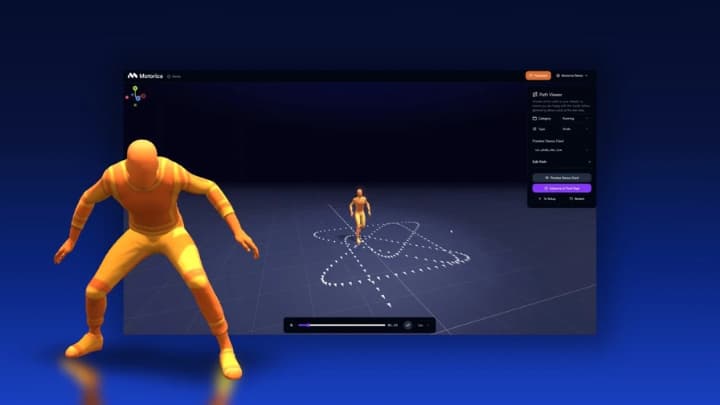
The system has 100+ animation templates to start with. If you want something different, you can use Style Cloning. You have to upload 1o minutes of mocap data and Motorica will enhance it by adding respective motion. You can also save this custom digital actor for your future projects.
2. Motion path:
This is where Motorica bridges the gap of technical and creative aspects. The platform offers two approaches that cater to different types of creators:
Procedural Path Definition appeals to technical artists who want systematic control. Instead of manual keyframing, animators can define high level movement intentions—”walk from point A to point B while looking around nervously”—and let the AI handle the biomechanical details.
Hand-Drawn Paths serve the more artistically inclined. Imagine sketching a character’s journey on a napkin, then watching that rough sketch transform into fluid, realistic movement. This approach removes the technical barrier that often intimidates traditional artists transitioning to 3D animation.
3. Export:
Generate and Export is where many AI animation tools breaks the animation curve, but Motorica seems to have cracked the integration challenge. The direct export to industry standard 3D softwares (Unreal, Unity, Maya, Blender, Cinema 4D) addresses a critical workflow solution.
Benefits of AI in Animation industry
Time savings represent the most obvious advantage. Projects that previously took months now complete in weeks or days. Cost reduction follows naturally from time savings. Studios spend less on animator salaries and production overhead. These savings can fund more creative projects or improve other aspects of production quality.
Quality consistency is another major benefit. Human animators have good days and bad days. Fatigue affects their work. Generative AI for character animation maintains consistent quality regardless of project duration or complexity.
The technology also democratizes high-quality animation. Small studios can now compete with major production houses. Independent creators gain access to tools that were previously exclusive to big-budget projects. Iteration becomes much faster with AI assistance. Directors can request animation changes and see results immediately. This rapid prototyping allows for more creative experimentation during production.
Studios can also tackle more ambitious projects. When basic animation becomes automated, teams can focus on complex storytelling, innovative camera work, and artistic direction. Film studios use the technology for background characters and crowd scenes. Creating hundreds of unique walking patterns manually would be impossible. AI generates diverse, natural-looking movement for every character in large scenes.
To talk about small screen and OTT platforms, they will also get benefits from the speed improvements. These operate on tight schedules with limited budgets. Generative AI for character animation helps teams meet deadlines without sacrificing quality. Streaming platforms drive huge demand for animated content. Services like Netflix, Hulu, SonyLiv, Zee 5, Disney+ and many others need constant new shows and movies. Generative AI for character animation helps studios produce content fast enough to fill this pipeline.
Video game developers face unique challenges with character animation. Games need thousands of movement variations for interactive characters. Players expect smooth transitions between different actions. AI-generated animation provides the volume and quality games require.
Challenges of AI and ML based tools
Generative AI and ML tools still faces several challenges. Creating truly emotional performances remains difficult. While AI can generate technically correct movement, capturing subtle human emotions requires more development. Style consistency across long projects can be problematic. AI models might generate slightly different movement styles between scenes. This inconsistency requires human oversight and correction.
The technology works best with human like characters. Fantasy creatures, robots, or highly stylized characters present greater challenges. AI models trained on human movement don’t translate perfectly to non-human subjects. Computing requirements still remain substantial. High quality generative AI for character animation needs powerful hardware. Smaller studios might struggle with the technical infrastructure requirements.
Integration with existing workflows takes time and effort. Studios must adapt their production pipelines to incorporate AI tools effectively. This transition period can temporarily slow down production.
Future of AI based 3D softwares
Apart from Motorica, other players include established animation software companies adding AI features to existing tools. Adobe, Autodesk, and similar firms are integrating generative capabilities into their professional software suites. Research institutions also contribute to advancing generative AI. Universities publish new techniques and improvements regularly. This academic research feeds into commercial applications.
Open-source projects make basic AI animation tools available to everyone. While less sophisticated than commercial solutions, these projects help spread the technology and encourage experimentation.
It will continue evolving rapidly. Future developments will address current limitations while adding new capabilities. Emotional intelligence in AI animation will improve significantly. Next generation systems will better understand character psychology and emotional context. This advancement will create more compelling and believable performances.
Artists will guide AI systems through natural language or gesture inputs. This partnership will combine human creativity with AI efficiency. The democratization of professional animation will accelerate. Independent creators will gain access to Hollywood quality tools. This accessibility could lead to an explosion of diverse, creative animated content.