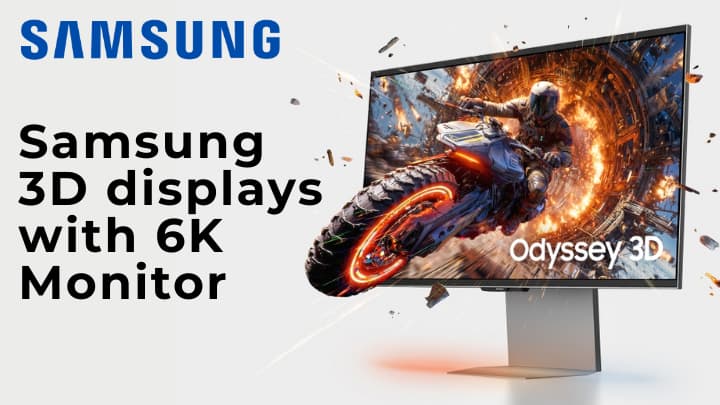
A big news for Gaming industry – Samsung 3D displays are announced. But this time, they say it’s different. The company will show off a new gaming monitor at CES 2026. It’s a 32-inch screen with 6K resolution. The big feature? It shows 3D images without glasses.
This might sound familiar. Nintendo tried it with the 3DS handheld. TV makers pushed 3D TVs in the early 2010s. But, both faded away pretty quickly.
Samsung 3D displays with 6K Monitor
Previous 3D screens had a major problem. They looked blurry. Here’s why: To create 3D depth, a screen needs to show two different images at once. One image goes to each eye. This trick makes your brain see depth. But older screens didn’t have enough pixels. When they split the image in two, the picture quality dropped by half. Gamers ended up with fuzzy, unclear visuals. Many people got headaches instead of immersion.
Samsung isn’t giving up on 3D technology. While other companies moved on, Samsung kept working on it. Their answer is simple: more pixels.
A 6K screen on 32 inches gives you extremely high pixel density. Even when the monitor splits the image for 3D, there are still enough pixels left over. The picture should stay sharp and clear. That’s the theory, at least.
One thing is for sure. They believe in market disruption. In 2017, they had revealed world’s first 49 inch wide(st) QLED Gaming monitor. It comprised CHG90 (49 inch) and CHG70 monitors (27 and 32 inch).
Huge improvement in refresh rates
The 3D monitor isn’t the only news. Samsung’s new Odyssey lineup includes displays with 1040Hz refresh rates.
Let’s put that in perspective. Most competitive gamers use monitors with 240Hz or 360Hz. That’s already considered fast.
1040Hz is nearly three times higher than the current top tier. At that speed, motion blur basically disappears. Every movement on screen would be incredibly smooth. There’s a catch, though. You need a graphics card powerful enough to push that many frames per second. Current GPUs can’t do it. Samsung is betting on future hardware.
If the technology works, it could change how we play games. Imagine a racing game where you can judge distances naturally. Or a strategy game where units have real depth on the battlefield. The immersion factor could be huge. You wouldn’t just look at a screen. You’d look into a space.
Tech challenge
Hardware is only half the story. Games need to support this technology. If Samsung makes glasses-free 3D work, game developers might pay attention. A major company backing the tech gives it credibility. Studios might start building 3D rendering into their engines again.
But developers won’t invest unless the hardware actually sells. Running these monitors won’t be easy. 6K resolution already demands a lot from your PC. Adding 3D makes it worse. 3D rendering means your graphics card draws the scene twice.
Combine 6K resolution with 3D rendering and high refresh rates? You need serious computing power. Current consumer GPUs simply can’t handle it. Samsung must be counting on major GPU improvements by 2026. Or they’re targeting only the highest-end enthusiast market. People who buy $2,000 graphics cards and don’t blink.
The Odyssey brand
Samsung is putting this under the Odyssey brand. That’s their flagship gaming line. They’re not treating this as a concept or experiment. They plan to sell these monitors to actual customers. It’s a real product aimed at serious gamers.
That’s a bold move. Samsung is betting real money that the market wants glasses-free 3D. But, there is a catch here.
Move your head too far left or right? The effect breaks down. Lean back or forward too much? Same problem. Samsung needs to solve this. If the sweet spot is too narrow, the monitor becomes frustrating. You’d constantly adjust your position to maintain the 3D effect.
We’ll find out at CES 2026 whether they’ve cracked this problem. A 32-inch 6K monitor with no-glasses 3D could be impressive. Or it could be another failed experiment. The gaming industry will watch closely.