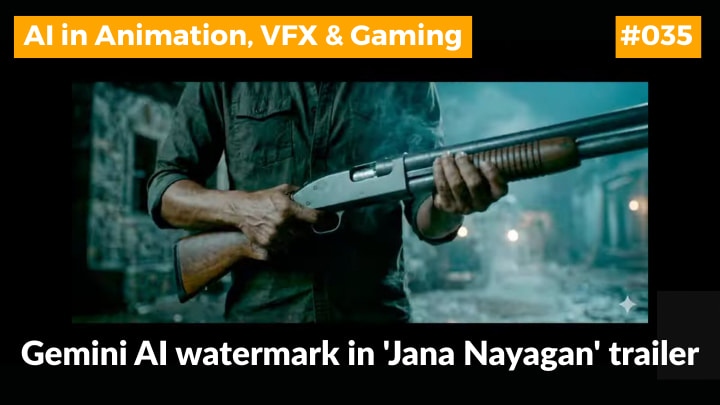
The official trailer for Thalapathy Vijay’s much-anticipated final film, Jana Nayagan, dropped on January 3, 2026. It has already generated massive hype as the actor prepares to shift focus to his political career with Tamilaga Vettri Kazhagam (TVK). The trailer promised heavy visuals and emotional depth. However, excitement quickly turned to controversy when netizens spotted a Google Gemini AI watermark in a frame of a trailer at 00:23 second.
For the firs time, the controversy is not related to acting, storyline, subject. It is regarding the use of Generative AI in movie production. It has raised serious questions about quality control in big-budget productions. As per reports, the production budget of Jana Nayagan is approximately ₹300 to 400 Crore. In such case, it is a gross mistake. All are calling it as fundamental failure in the post production workflow. It reveals how rushed and careless the editing process was.
Let’s understand what went wrong, why it matters, and what this controversy reveals about the current state of AI integration in Indian cinema.
The technical mistake in the ‘Jana Nayagan’ trailer
The technical explanation is straightforward.
Someone on the Jana Nayagan post production team used Google Gemini AI to generate or enhance a shot. This could have been for quick visualization or testing. The problem? They exported the AI-generated image without removing the watermark. No one in the entire VFX crew caught this mistake before the trailer went public and netizens spotted it.
It is a huge quality control failure.
Being a VFX Compositing artist myself, I can confirm that removing or avoiding watermarks is literally the first thing any professional learns. Every major compositing software, from Nuke to After Effects, can do it easily. The fact that this slipped through suggests either extreme time pressure, inadequate review processes, or both.
The shot is nothing complex at all. It’s a simple close-up of hands loading a shotgun. This is the kind of shot that could be filmed practically in less than an hour with a proper setup. Using AI for such a straightforward visual raises questions.
If it needs to be a post shot, this should have happened in a standard VFX pipeline:
- Shot requirement identified during pre-production / previz.
- If practical filming is chosen, the live action shooting should have been done with chroma and prop.
- If CGI creation is chosen, it would required proper shooting with track marks. It post, it would require process of 3D tracking / matchmoving, multi pass rendering and final compositing.
- Quality checks on the final output.
- Color grading
- Final approval from director and producers
None of it happened. In a nut shell, it is a system failure.
Gemini AI watermark in Jana Nayagan trailer
Within hours of the trailer’s release on YouTube, social media paused the video at the 0:23-second mark during a montage sequence showing a character loading a shotgun. A brief frame revealed the official watermark of Google’s Gemini AI at in the bottom-right corner.
Screen recordings and screenshots went viral, with posts like “No f***ing way they used an AI generated shot in Thalapathy Vijay’s Jana Nayagan and forgot to remove the Gemini logo” amassing thousands of reposts. Hashtags such as #JanaNayaganTrailer and #JanaNayagan trended heavily, blending fan excitement with criticism.
Some of the major key reactions included:
- ₹400 crore budget but can’t remove a watermark? Rookie mistake!
- Using AI for such simple shots is alarming & raising doubts on filmmaking standards.
- Some called it an “absolute insult to cinema,” while others noted it as evidence of AI’s growing role in production.
- Didn’t even used the premium version of Google Gemini AI.
By the next morning, the watermark was quietly removed from updated versions of the trailer, but viral clips ensured the backlash continued. The damage is already done. No official statement has come from the makers or director H. Vinoth.
Pros and cons of AI in trailer and movie post production
Generative AI tools like Gemini, Sora, Veo are increasingly used in film marketing. They are best suited for quick asset creation, filler shots, or enhancements. Well, these are used specially under tight deadlines.
| Aspect | Advantage | Disadvantage |
| Efficiency | Fast generation of visuals effects | Risk of oversight (like visible watermarks) damaging credibility |
| Creativity | Allows experimentation with concepts or SFX previews | Looked as ‘lazy’ replacement for practical filming or traditional VFX |
| Production cost | Cost effective for non-critical elements | Raises ethical questions about transparency and job displacement in post-production |
| Audience reaction | Wow factor when it is seamless, like use of Generative AI in Netflix’s The Eternaut | Huge backslash which happened in the case of Vijay’s Jana Nayagan |
While some defended it as a minor trailer-only oversight which will not be in the final movie. However, the incident raised growing use of AI in filmmaking and VFX / post production pipeline.
Future of AI in film production
This episode highlights AI’s rapid integration into mainstream Indian filmmaking, from posters to trailers. Tools like Gemini offer transparency via watermarks to promote responsible use, but incidents like this highlights the need for proper post production checks.
Generative AI has legitimate uses in modern filmmaking. It can help in the following complex modules:
- Rapid previsualization
- Background enhancements
- Crowd replication
- Creating complex VFX shots faster
AI tools can be genuine game changers, if used wisely. Major studios worldwide are experimenting with these technologies to optimize workflows and reduce costs.
However, there is a right way and a wrong way to integrate AI into post production pipelines.
The right way involves using AI as a tool to support artists, not to replace them. It means maintaining quality standards regardless of the technology used. It means having proper review processes to catch errors. You must also be transparent with audiences about when and how AI is being used.
The wrong way is what we witnessed with Jana Nayagan. Rushed execution and poor qc check. It betrayed the trust of audiences who are paying premium prices for supposedly premium content.
Conclusion
It is surely a wake up call for Indian Cinema’s production pipeline.
Directed by H. Vinoth and produced by KVN Productions, the action thriller casts Vijay as a vengeful cop, alongside Pooja Hegde, Bobby Deol, and others, with music by Anirudh Ravichander. It is set for a Pongal release on January 9, 2026.