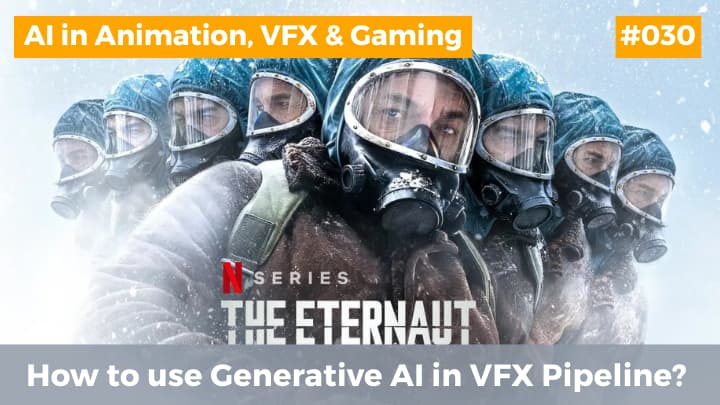
In the latest genre of generative AI movies, one remarkable example is Netflix’s adaptation of the Argentine sci-fi classic The Eternaut (S01, 2025). This groundbreaking project incorporated the use AI and ML tools to create final and on-screen VFX. It set a new benchmark and captured the attention of global filmmakers and industry professionals. Generative AI VFX is revolutionizing everything from Animation, visual effects to post production pipeline and costs.
Let’s learn how generative AI in film VFX works, the impacts it’s having, and what the future might hold.
What is Generative AI movies?
It refers to artificial intelligence systems that produce new images, video, or audio based on prompts or instructions. In VFX (visual effects), AI can create backgrounds, simulate destruction, or generate detailed environments.
Tools of Generative AI VFX are based on machine learning models (e.g., GANs, diffusion models). They can:
- Generate realistic images or backgrounds from simple text prompts or sketches.
- Enhance or replace traditional CGI by automatically creating visual elements like environments, explosions, weather, or even characters.
- Automate VFX works of rotoscoping, cleanup, de-aging, face replacement, and more.
- Set extension, like filling in futuristic cities or alien landscapes.
- AI avatars or basic level of digital doubles.
- Making the final output look like a painting or animating a static image.
- Previsualization becomes very fast by quickly mocking up complex scenes before actual filming or CGI work begins.
- It can give the output on the scale of manual compositing of live action plates with CGI render passes.
Generally, such tasks require many hours of manual artist work. But, with the help of AI and ML, the post production / VFX pipeline can generate results 10X faster. Overall, it reduces time spent on manual animation or design. To talk about budget, it can easily cut down on extensive VFX labor and resources. You can create more visual content for films, television, and other means of broadcasting media.
Importantly, generative AI doesn’t replace artists. Instead, it acts like a smart tool that supports and enhances the work of VFX professionals.
There is another upcoming full fledged movie which is completely made by AI. Naisha is India’s first AI generated movie. Such scale has never been achieved before. From the release of the trailer, it has created a vibrant buzz in the industry. Runway, Kling and Pica Labs are used to create and animate all the digital characters. For voice, Vivek Anchalia, the Director used ElevenLabs.
Use of Generative AI VFX in Netflix’s The Eternaut: A case study
Netflix’s The Eternaut made headlines for its innovative use of generative AI. For the record, it is the first official public deployment of said technology for final on-screen visual effects. It is confirmed by Netflix executives, including co-CEO Ted Sarandos. He stated that ‘Our creators are already seeing the benefits in production through pre-visualization and shot planning, and certainly visual effects.’. So, the goal is to enhance human creativity, not to cut the jobs.
The sequence is of a massive building collapse in Buenos Aires, a scene that might have taken weeks of work in the past, if we use our typical post production pipeline.
Check out the key details at a glance.
| Criteria | Standard post production / VFX pipeline | Generative AI VFX pipeline |
| Scene delivery time | Weeks | 1-2 days |
| Estimated cost savings | None | 80% compares to standard VFX pipeline |
| Team size needed | Large (Modeling, Texturing, Lighting, Animation, FX, Roto, Paint, Tracking, Compositing) | 2-3 artists |
The speed or turnaround time is the key factor here. The Netflix VFX team completed this sequence nearly 10 times faster than with traditional methods. They could create a high quality visual effects scene on a smaller budget.
Both Netflix and the show’s creators praised the results. It also got almost all positive response from worldwide audience. Well, there has been raised concerns about job impact, which is discussed ahead in this article. Overall, people also praised Netflix for their transparency.
Check out the final 5 second video of Netflix’s The Eternaut, created entirely by Generative AI.
Being a VFX Compositing artist myself, I can say this is a pretty good output as only AI based tools are used. The small 5 second shot is a groundwork for upcoming bigger sequences.
If we breakdown this scene in terms of a standard VFX pipeline, it will have following elements.
- Chroma removal (green/blue keying, generating clean matte)
- Creation of a building (3D model, texturing)
- Creation of the surrounding CGI environment
- Collapsing of the building (FX / simulation, debris, fog, multiple interactions)
- CG render passes (beauty, occlusion, shadow, lighting, depth and many other as per client requirement)
- Final composting of live action shooting plate and 3D render passes
- Color grading / cc match of entire sequence
If we use above mentioned visual effects workflow, the final output can be much more realistic and immersive. But, it is not a hero shot. So, we can surely save a huge production cost on such shots.
In totality, it seems a wise decision of Netflix team to incorporate such AI based outputs in the series to save cost, wherever possible. It will open up new pipelines and workflows, which will reduce the entire post production time.
The Generative AI VFX workflow
The actual pipeline is complex with so many technical terms. Here is a simplified look at how generative AI movies can be made.
- Artists describe the scene or effect they need through prompt engineering. It works as a foundation.
- VFX artists and prompt engineers refined these AI generated images / videos and blended them with live action footage.
- The output is polished for continuity.
- The final cut is made with proper grading / color correction.
This cycle may repeat several times for each scene, combining innovation with creative judgment.
This hybrid approach created fast and visually impressive results. It showed that how this technology is moving from test labs to high end and onscreen production in generative AI movies.
Industry response
But naturally, professionals discussed these advances with excitement and caution, mainly on LinkedIn and Reddit.
Many users point out that generative AI lowers technical and financial barriers. Smaller productions can now achieve visual effects that once required higher budgets. Complex scenes can be completed in days instead of weeks or months. This could broaden the range of movies, ads and web series. Directors and artists can dream bigger and create scenes that might once have been impossible or unaffordable. It can be a boon for Indie studios.
Some worry that as AI takes on more VFX work, there may be fewer opportunities for entry level artists. There are also ongoing debates about creative control and the possible loss of the human touch in the creative output. We have already seen mass VFX layoffs from Technicolor Group (MPC, The Mill, Mikros Animation) and DNEG. It also surfaced the 2023 Hollywood writers’ strike, highlighting ongoing debate about labor protections as studios increase the use of such tools in the post production pipeline.
But, some agrees that while AI speeds up certain tasks, human oversight and artistic sensibility remain irreplaceable for quality and storytelling. It will also open new job titles which is fusion of AI and VFX artists.
Conclusion
Generative AI’s use in The Eternaut signals the start of a new era for film VFX. By blending AI and ML tools with artists, filmmakers can bring grand visual effects in faster and more affordably than ever before. We need to ensure that the use of AI in film should be both thoughtful and innovative. It should not come as a risk to the VFX industry employment.
We are expected to see more collaboration between human creators and AI technology.