
As per the earlier reports, the production budget of Namit Malhotra’s Ramayana 1 was 800+ Crore. But, as per yesterday’s latest news, the combined production budget of Ramayana series is 4000 Crore. This being India’s most expensive production naturally raises questions about how commercially box office successful will it be. However, if you evaluate the facts and figures, this calculated risk looks worth taking.
The incredibly positive reaction to the first trailer of Ramayana 1 points to strong audience interest. The international markets also respond to this level of cultural specificity of the Hindu mythology to cinema translation.
Let’s understand why this two part Ramayana series can be a colossus success.
1. Shifting perspective of the global cinema
The Superhero Dominance is fading out in the current cinematic landscape. While revenues are up 15% from 2024, they’re still down 26% from 2019. It is a great opportunity for Namit Malhotra’s Ramayana series. Other than ‘Deadpool & Wolverine’, superhero cinema has suffered a major box office drought. They all had the same kind of treatment. Majority of them are Animation and VFX heavy, minus the storytelling and emotional appeal. They are failing to connect with the audience.
It has created a big vacuum. And it is the perfect time for a culturally rooted movie like Ramayana. Namit Malhotra (CEO, DNEG) has a visionary approach for this epic 2 part movie. His innovative ideas, combined with the current phase of M&E industry, lead to very potential commercial success. He sure has a historical data to back up. Films like Troy (2004) and Clash of the Titans (2010) found international success despite cultural differences.
Recently, SS Rajamouli’s RRR and Baahubali along with KGF have seen worldwide success. It proves that the audience is accepting new culture and storytelling. The ‘Naatu Naatu’ song from RRR had also won the Academy Award for Best Original Song at the 95th Academy Awards. It shows that the international audience has an appetite for Indian storytelling.
Given below are some of the staggering success stories of Indian movies in global market.
| Year | Movie | Budget | Box office | ROI |
|---|---|---|---|---|
| 2016 | Dangal | 70 Crore | 2200 Crore | 3043% |
| 2017 | Baahubali 2 | 250 Crore | 1810 Crore | 624% |
| 2022 | RRR | 550 Crore | 1387 Crore | 152% |
| 2022 | KGF 2 | 100 Crore | 1250 Crore | 1150% |
| 2024 | Pushpa 2 | 500 Crore | 1800 Crore | 260% |
2. Partnership with Warner Brothers for global distribution
This one is a great strategic move. The team will balance the cultural authenticity vs. global appeal. Nitesh Tiwari needs to make sure that both the parts strike a balance between devotional respect and universal storytelling.
In the Media & Entertainment world, Warner Brothers has gigantic global reach. Having a partnership with WB indicates that Hollywood is recognizing Indian cinema’s growing influence. This isn’t just about reaching Western audiences; it’s about validating Indian storytelling as a global product worthy of major studio investment.
Beyond immediate box office concerns, Ramayana offers a new blueprint for how regional cinema can find global relevance. By blending specific local culture with universal production values, it suggests a way forward for non-Hollywood films in our interconnected world.
The success or failure of Namit Malhotra’s Ramayana will likely influence how other major film industries approach their own cultural narratives. If Ramayana shows that audiences will embrace high-quality, culturally authentic storytelling regardless of origin, it could encourage similar investments in Chinese, African, or Latin American cinema.
It is also possible that it gets screened at major international film festivals before commercial release. This could build critical acclaim and word of mouth.
3. AI Powered Ramayana
At WAVES 2025 event, Namit Malhotra showcased his bold vision for Ramayana movie.
Having DNEG, the Oscar-winning VFX company, on board means this project is set to be a visual spectacle that could set new standards for Indian cinema. But the real game changer is his plan to use AI for global localization. The AI based lip sync technology will be used for foreign languages including English, Spanish, French and Japanese. So, there will be no need for subtitling or dubbing. It will feel more like a native movie.
This is a huge leap in making Indian films truly accessible worldwide. On a larger scale, Namit’s Ramayana is a boon for global filmmaking.
Such lip-sync technology will open up new ideas for future filmmaking. The director will be able to convey his/her storytelling, without worrying about technical details of subtitling or dubbing. The soul of the movie will not be sacrificed via this. This tech is going to evolve on a large scale. This positions Ramayana as a technological pioneer, not just any other movie.
4. VFX of Ramayana from DNEG
The VFX of Ramayana 1 from DNEG carries the weight of cultural responsibility. Multiple 3D Animation and VFX artists are working in global pipeline (India, Canada and UK) to deliver a mammoth and immersive experience.
The film’s approach to heavy VFX could also change how Indian filmmakers tackle mythological narratives. Instead of relying on traditional practical effects or lower-budget CGI, this project shows that Indian studios can achieve Hollywood-caliber visual grandeur.
DNEG has successfully delivered Animation and VFX of Brahmastra. So, the tech team already have the following:
- Full body scans and digital double of Ranbir Kapoor
- 3D assets including multiple environments (forest, village, terrains etc.)
- Particle effects
- Many other Houdini based simulations and dynamics
So, all the animators and visual effects artists will have ease to work on Ramayana 1 and 2. They will spend more time to optimize the post production pipeline and workflow. They can focus more on Yash’s digital double and his unique effects.
To go beyond all these, the VFX supervisor team has used 86-camera volumetric capture. This photogrammetry setup goes beyond the standard motion capture system. The said tech, which was used for Christopher Nolan’s blockbuster Interstellar movie, captures actual geometry and highly detailed texture data. It can produce hyper real digi doubles.
After seeing the Ramayana 1 trailer, the VFX artists can easily confirm that the particle cloud / simulation is Houdini based. Like VFX of Brahmastra, SideFX Houdini will again become a visual effects hero here for the post production of these two part franchisee.
Namit Malhotra and the entire DNEG team are very well aware of Adipurush’s box office bomb. They will not repeat the mistakes of lousy VFX and inappropriate character portrayals. The Ramayana 1 trailer already showed the dignity in character representation and clean visual effects.
5. Music
The collaboration between Hans Zimmer and A.R. Rahman for the music of Ramayana represents one of the most significant partnerships in contemporary film music history. It’s not just about blending Western and Eastern sounds. The idea is to create a music that goes beyond cultural lines while keeping the spiritual depth of the movie. Rahman’s grasp of Indian classical music combined with Zimmer’s mastery of grand orchestral scores could create something truly groundbreaking.
The fusion of two distinct musical philosophies will surely redefine the epic storytelling. This collaboration marks Zimmer’s Bollywood debut as a music composer, with his partnership with Rahman being described as a surprise for Indian fans.
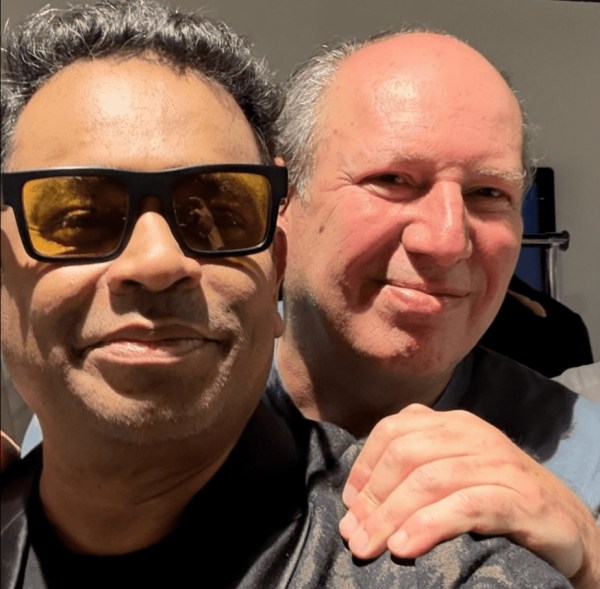
The German-American composer, Hans Zimmer, has composed music for over 100 films, bringing a vast reservoir of orchestral expertise to this project. Some of the most notable includes Gladiator, The Dark Knight Trilogy, Inception, The Lion King and Interstellar. For Indian audience, Rahman doesn’t need an introduction at all. His ability to weave spiritual themes into contemporary soundscapes makes him the perfect counterpoint to Zimmer’s grand orchestral sensibilities.
6. Two part series of Ramayana movie
Namit Malhotra’s Ramayana is a two part series. The overwhelmingly positive fan reactions, with many talking about “goosebumps” from the first glimpse, suggest that Malhotra has managed to hit the right note between reverence and innovation. This is crucial, as adapting religious texts for the big screen always carries the risk of cultural backlash.
The decision to focus Part One on Ravana’s origin story is quite clever. By exploring the “beginning of evil,” the film can delve into complex themes while maintaining the clear moral compass that makes the Ramayana universally appealing. This approach also allows for character development that pure action spectacles often lack.
What’s particularly clever about Malhotra’s strategy is the release timing during Diwali 2026 and 2027. This positions the films as major cultural events, not just regular entertainment, creating must-see viewing that goes beyond typical box office numbers.
7. Financial prediction of Ramayana’s box office success
If we talk about potential risk, the film needs to collect approximately Rs. 8000 to 10000 Crore globally to break even to justify the production budget of Rs. 4000 Crore. To achieve this gigantic figure, it would require to outperform even the highest-grossing Indian films by massive margins. If we take 8000 Crore as a base level, then it should collect around 3000 Crore from the Indian market and around 5000 Crore from the international market.
Like Dangal, Ramayana movies also need penetration in China, which is essential for reaching these numbers. Ramayana 1 and 2 are filmed for IMAX. It means that each frame has ultra high texture details. This format will also help to get premium revenue from the box office.
Following are other factors which can affect long term profitability and global reach of Namit Malhotra’s Ramayana franchise:
- OTT / streaming rights (Seeing the past purchases, the estimated amount can be 800 to 1000 Crore from Netflix/Amazon Prime)
- Merchandise opportunities
- Theme park licensing
- Gaming licenses
- Music rights
- AI lip-sync technology licensing to other productions
Conclusion
Ultimately, Namit Malhotra’s Ramayana is more than just ambitious filmmaking. It’s a powerful statement about Indian cinema’s readiness to compete on the global stage without losing its identity. The early reactions suggest audiences are ready for this evolution, but the real test will be whether the film can live up to its immense promise. No one had ever thought that Valmiki’s Ramayana will take such gigantic and, yet true to its cultural aspects.
In a world increasingly looking for authentic stories that cross borders, Ramayana could either validate this approach or serve as a cautionary tale about the limits of cultural adaptation. Either way, it marks a truly significant moment in the ongoing globalization of cinema, where success will be measured not just in ticket sales, but in cultural impact and industry transformation.
Perhaps the most significant impact of this project is its potential to elevate industry benchmarks. If Ramayana succeeds, it could prove that Indian films can stand shoulder-to-shoulder with Hollywood blockbusters in terms of technical quality, all while staying true to their cultural roots. This would likely inspire a wave of similar high budget and culturally rich projects. It will create a positive domino effect on Indian Cinema.